
Key points
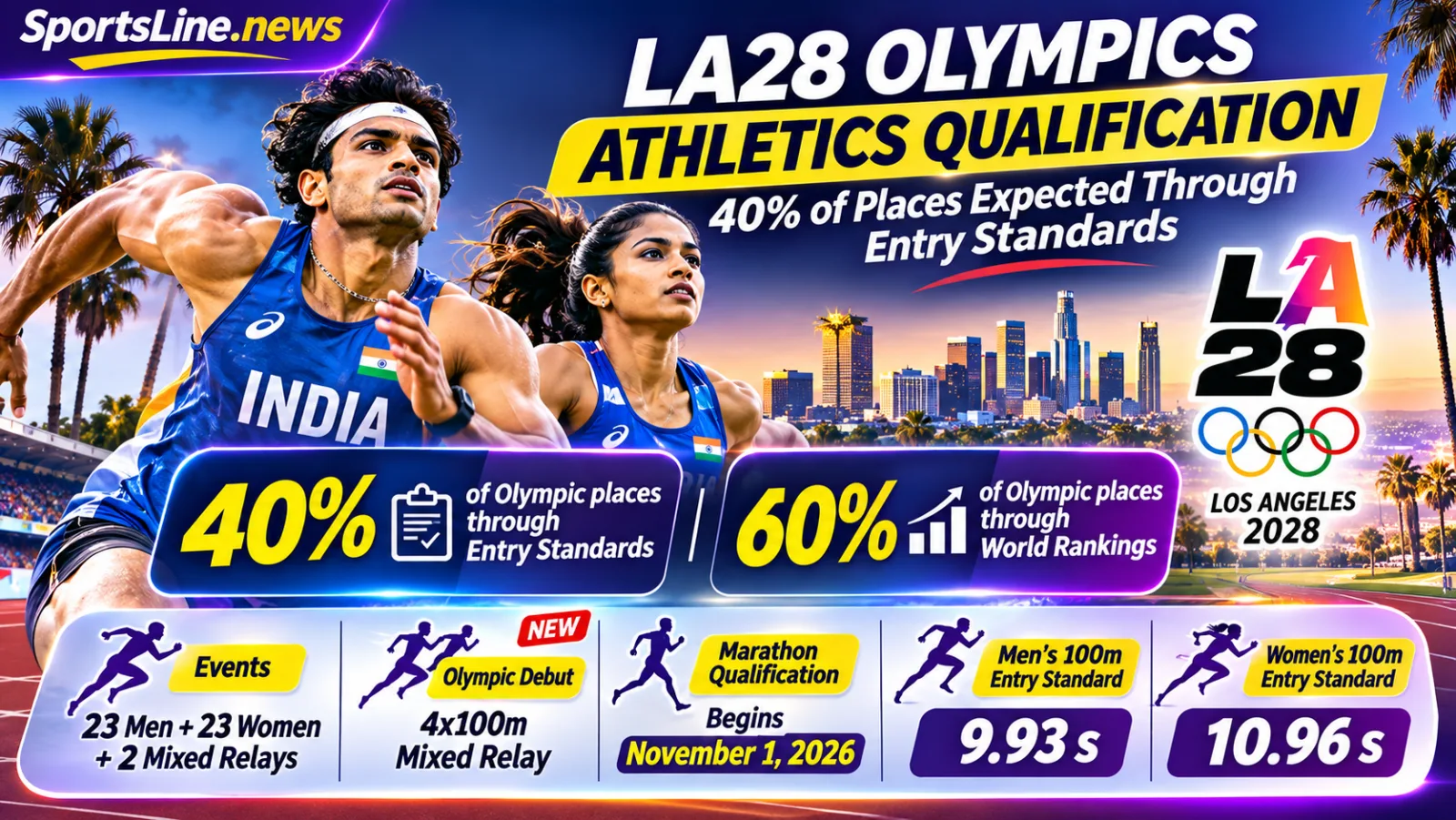
- World Athletics published the athletics qualification system for the Los Angeles 2028 Olympic Games on November 10, 2026; the Games athletics competition is scheduled for July 15-30, 2028.
- The programme features 23 events for men, 23 for women and two mixed events: the 4x100m mixed relay, which will make its Olympic debut, and the 4x400m mixed relay.
- The qualification model expects 40% of athletes to qualify through entry standards and 60% through world rankings, replacing the previous 50-50 approach.
- Achieving an entry standard does not automatically guarantee qualification if more athletes meet it than the event quota allows; the best performances within the quota will be selected and no ranking places will be award
- The marathon qualification window runs from November 1, 2026, to April 30, 2028; 10,000m, combined events, race walks and relays run from December 19, 2026, to June 18, 2028; other events run from June 19, 2027, to June
- The entry standards include 9.93 seconds for men's 100m and 10.96 for women's 100m; marathon standards are 2:05:00 for men and 2:22:20 for women.
World Athletics has published the qualification system for athletics at the Los Angeles 2028 Olympic Games, setting out entry standards, ranking pathways, event quotas and qualification windows for the sport's Olympic programme. Under the new system, 40% of athletes are expected to qualify by achieving entry standards, while the remaining 60% are expected to earn places through world rankings.
The system, announced on November 10, 2026, covers 23 events each for men and women, alongside two mixed relay events. The 4x100m mixed relay will make its Olympic debut at LA28, while the 4x400m mixed relay also remains part of the programme. The athletics competition at the Games is scheduled to take place from July 15 to 30, 2028.
Dual pathway replaces the previous 50-50 model
The qualification structure follows a dual pathway, but changes the balance used in recent Olympic cycles. Rather than an even split between entry standards and rankings, World Athletics expects around 40% of the available athlete places to be filled by athletes who achieve the published standards. The other 60% are expected to be allocated through world rankings.
World Athletics has also clarified that reaching an entry standard does not automatically secure an Olympic place. If more athletes achieve the standard than the quota allows in a particular event, places will go to the best performances within the available quota. In that situation, no athletes will qualify through the world-ranking route for that event.
The approach is intended to combine direct performance marks with ranking-based access across the global field. It also means athletes and national federations will need to track both their marks and their position in the qualification rankings throughout the relevant period.
Qualification windows differ by event
The qualification periods are not identical across the athletics programme. The marathon window is the earliest to open, running from November 1, 2026, to April 30, 2028. This gives road runners an extended period in which to achieve the standard or build a qualifying position through the designated ranking system.
For the 10,000m, combined events, race walks and relays, the qualification period runs from December 19, 2026, to June 18, 2028. All other events, including the sprints, middle-distance races, hurdles, jumps and throws, will use a window from June 19, 2027, to June 18, 2028.
World Athletics says results from competitions whose final day falls within the relevant qualification period will count. Results at national senior outdoor championships that begin within the period can also count if they are achieved no later than June 22, subject to the published rules.
Key entry standards across track and field
The standards set demanding benchmarks across the programme. In the 100m, the men's standard is 9.93 seconds and the women's is 10.96. The 200m standards are 19.95 and 22.25 seconds respectively, while the 400m marks are 44.40 for men and 49.90 for women.
In distance running, the men's and women's standards are 3:30.00 and 3:57.50 for the 1500m, 12:50.00 and 14:34.00 for the 5000m, and 26:48.00 and 30:30.00 for the 10,000m. The marathon standards are 2:05:00 for men and 2:22:20 for women.
The field-event standards include 8.30m in the men's long jump and 6.90m in the women's event. In the javelin, the marks are 85.50m for men and 63.80m for women. The high jump standards are 2.32m and 1.97m, while the pole vault marks are 5.90m for men and 4.80m for women. The men's decathlon standard is 8,650 points and the women's heptathlon standard is 6,550 points.
Special routes for marathon, race walks and relays
The marathon has a specific ranking process. On March 19, 2028, athletes ranked within the top 56 on the filtered Road to LA list, with a maximum of three athletes per country, will be considered qualified. The remaining 15 places will then be determined through the dual pathway without displacing those already qualified. The first five finishers at Platinum Label marathons during the qualification period will also be treated as having achieved the entry standard.
For the half marathon race walk, the first 12 finishers at the World Athletics Race Walking Team Championships in Hefei, China, on April 9, 2028, will qualify automatically. If a place is declined, it will be reallocated through the world rankings. The remaining 36 places will also be allocated through rankings.
Relay qualification will be decided in part at the World Athletics Relays in The Bahamas on April 22 and 23, 2028. The first 14 National Olympic Committees in each relay event will qualify automatically. Teams will have two opportunities at the event, with a second chance on day two for those that do not qualify on the opening day. Remaining places will be filled using the World Athletics relay performance list.
What the new system means for athletes
The published framework gives athletes and national federations a clearer timeline for planning their routes to Los Angeles. Sprinters, distance runners, jumpers and throwers will have to peak within their event-specific windows, while marathoners and relay squads have different timelines and dedicated qualification mechanisms.
World Athletics said the entry standards were developed using results from the qualification periods for the 2022, 2023 and 2025 World Athletics Championships and the Paris 2024 Olympic Games. The analysis considered performance trends and expected improvements, with the marathon standards also adjusted to reflect the faster times typically recorded in Olympic years.
The governing body plans to publish its Road to LA qualification monitoring tool in the latter part of 2027. Until then, athletes and federations can use the published standards and windows to map out their preparation, while final Olympic places will depend on performances, rankings and the quotas in each event.
Frequently asked questions
What is the qualification system for athletics at the 2028 Olympics?
World Athletics expects 40% of athletes to qualify through entry standards and 60% through world rankings. The system also sets event-specific qualification windows and quotas. Meeting the entry standard alone does not guarantee a place if more athletes achieve it than the event quota permits.
When does athletics qualification begin for the Los Angeles 2028 Olympics?
The marathon qualification period begins on November 1, 2026. Qualification for 10,000m, combined events, race walks and relays starts on December 19, 2026, while the window for all other athletics events begins on June 19, 2027.
What is the men's and women's 100m qualifying standard for LA28?
The published entry standard is 9.93 seconds for the men's 100m and 10.96 seconds for the women's 100m. Athletes must achieve the standard within the applicable qualification period, but final places remain subject to the event quota and the qualification rules.
Which mixed relay events will be held at the Los Angeles 2028 Olympics?
The athletics programme will include the 4x100m mixed relay and the 4x400m mixed relay. The 4x100m mixed relay will make its Olympic Games debut at LA28, adding a new mixed relay event to the track programme.
How will relay teams qualify for the LA28 Olympics?
The first 14 National Olympic Committees at the World Athletics Relays in The Bahamas on April 22-23, 2028, will qualify automatically. The remaining teams will be selected using the World Athletics relay performance list during the qualification period.