Published:
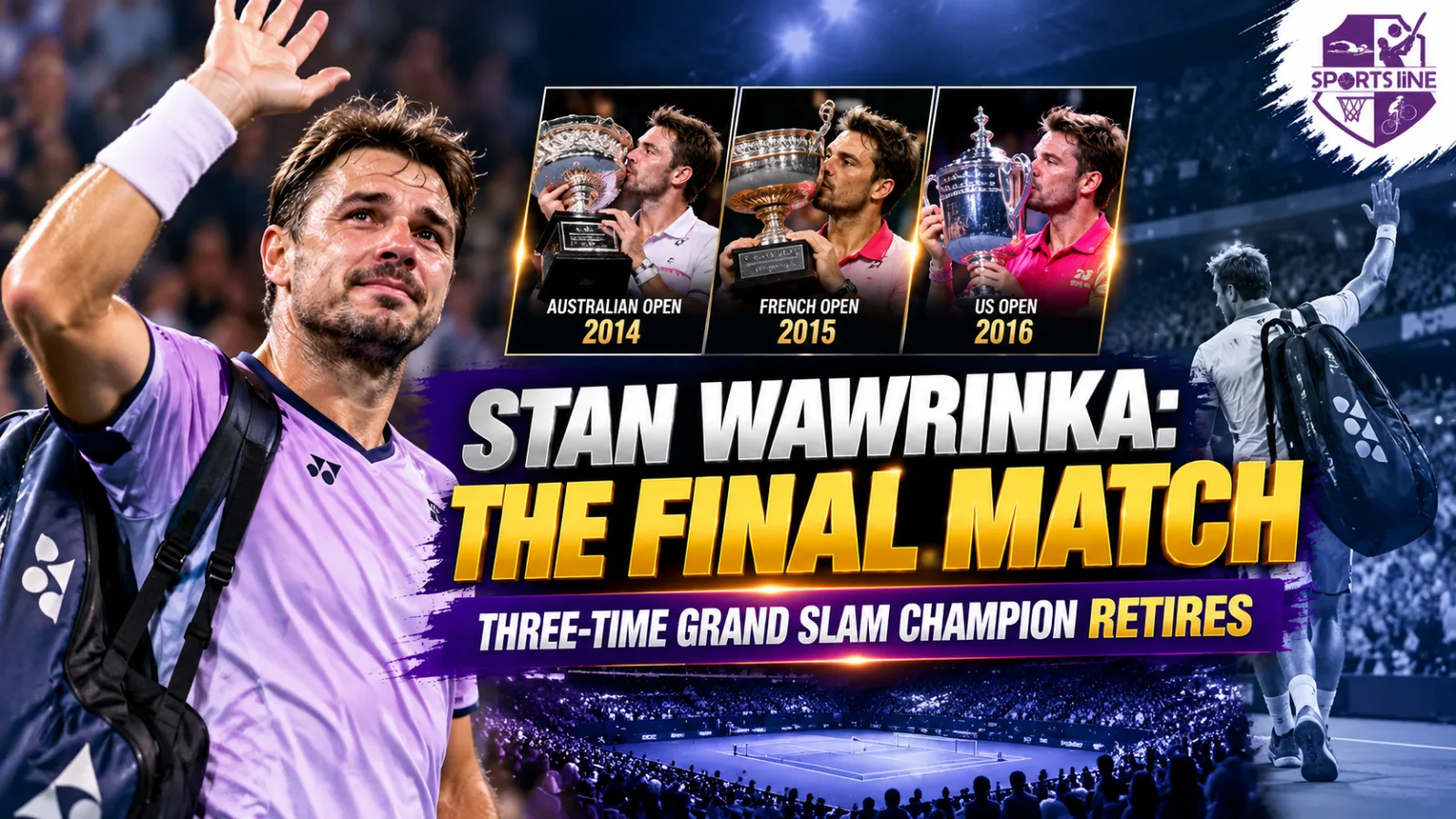
Stan Wawrinka’s professional tennis career has come to an end after the three-time Grand Slam champion lost in the first round of his final tournament, Hindustan Times reported on October 28, 2026. The Swiss veteran had announced that the 2026 season would be his last, bringing to a close a career defined by major titles, a powerful one-handed backhand and a series of victories over the sport’s biggest names.
The first-round exit was a modest final result for a player whose best days included three Grand Slam singles championships and a rise to world No. 3. Wawrinka’s career stood out because he broke through the dominance of the sport’s leading champions to win the Australian Open, French Open and US Open during the 2010s.
Wawrinka’s first major title arrived at the 2014 Australian Open, where he defeated Rafael Nadal in the final. It was a landmark breakthrough for the Swiss player, who had spent years competing in the shadow of compatriot Roger Federer and the established leaders of men’s tennis.
He followed that success with the 2015 French Open title, beating Novak Djokovic in the final. A year later, Wawrinka won the 2016 US Open, again defeating Djokovic in a Grand Slam final. Those victories gave him major championships on hard courts in Melbourne and New York and on clay in Paris, a range that underlined his ability to succeed across different playing conditions.
Wawrinka reached a career-high ranking of world No. 3 in January 2014. His achievements came during an unusually competitive period in men’s tennis, when Federer, Nadal and Djokovic accumulated the majority of the biggest titles. Wawrinka’s major wins made him one of the few players outside that trio to repeatedly break through at the sport’s highest level.
The 2014 Australian Open final was particularly significant because Wawrinka beat Nadal, who had been pursuing another Melbourne title. The victory established Wawrinka as a Grand Slam champion and demonstrated that he could perform under the pressure of a major final against one of the era’s dominant players.
His 2015 French Open run became another defining chapter. Djokovic entered the final in strong form, but Wawrinka’s aggressive groundstrokes and willingness to take the ball early helped him win the title. The result also denied Djokovic a chance to complete the career Grand Slam at that stage of his career.
At the 2016 US Open, Wawrinka again defeated Djokovic in the final. He later returned to the Australian Open final in 2017, where he faced Nadal and won in five sets. Together, those matches formed a rare record of major-final victories against the leading players of the era.
Wawrinka’s decision to make 2026 his final season meant that each tournament became part of a farewell tour for a player whose career spanned multiple generations of the professional circuit. The first-round defeat reported by Hindustan Times did not diminish the scale of his accomplishments, but it did bring his competitive career to a close earlier than a deep run would have.
The article’s report identifies the loss as the final match of Wawrinka’s professional career. Match-specific details, including the opponent and score, should be checked against the tournament’s official result before publication rather than inferred from the headline alone.
For tennis fans, Wawrinka leaves a legacy built on peak performances at the biggest events rather than a long accumulation of titles. His three Grand Slam championships, career-high ranking and victories over leading rivals ensure that he will be remembered as one of the most formidable challengers of the Big Three era.
Wawrinka’s career is a reminder that tennis history is not shaped only by players who dominate an era for a decade. His best results arrived when he produced his highest level in major tournaments, often against opponents who were favourites to win. The three Grand Slam titles gave him a place among the most successful players of his generation.
As the 2026 season closes, his retirement marks the departure of another established figure from the generation that shaped modern men’s tennis. His final first-round defeat may be the last line on his match record, but the defining memories remain the major finals he won and the top-ranked opponents he overcame to do so.
