
Key points
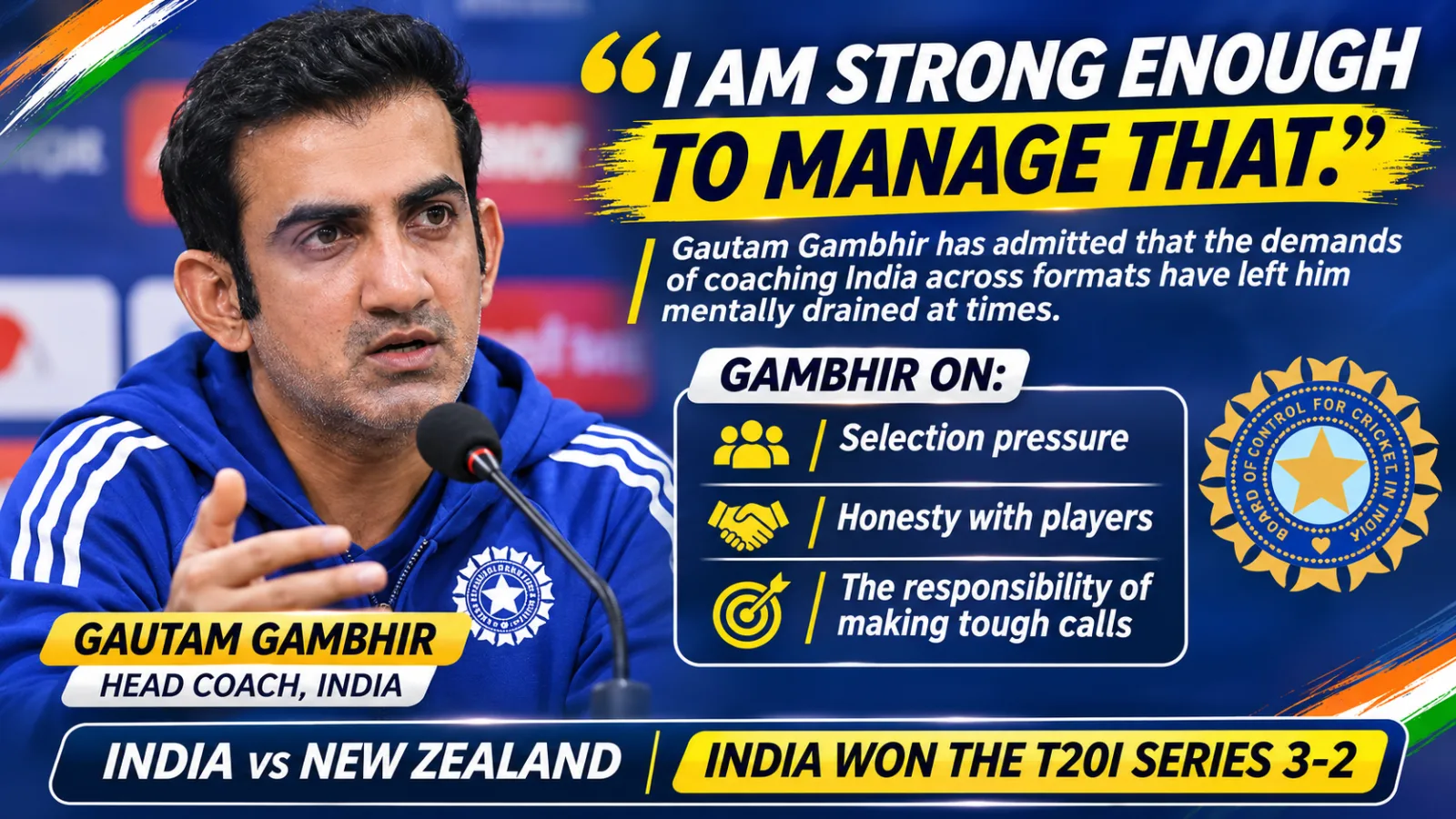
- Gautam Gambhir admitted that he has felt mentally drained while handling the demands of coaching India across formats.
- Gambhir said he was strong enough to manage the pressure and continue taking responsibility for as long as he could.
- He described the workload, travel and expectations placed on the India head coach as challenging, while saying he was enjoying the role.
- India won the five-match T20I series against New Zealand 3-2 after winning the first three matches and losing the final two.
- New Zealand won the fifth T20I by seven wickets in Hamilton, chasing India's 192-run target in 17.4 overs.
- Gambhir said a coach's job was to make the right decisions rather than popular ones, and stressed honesty and transparency in conversations with players.
India head coach Gautam Gambhir has acknowledged that the demands of the job have left him mentally drained at times, while insisting that he remains capable of handling the pressure. He made the admission after India completed a 3-2 T20I series victory over New Zealand, despite losing the fifth and final match in Hamilton on November 1, 2026.
Asked whether he had felt mentally exhausted while managing the team across formats, Gambhir answered candidly that he had. He added that he was strong enough to deal with the strain and was prepared to continue taking responsibility. His comments offered a glimpse into the workload behind the role of India's all-format head coach.
Gambhir acknowledges the pressure of the job
Gambhir said coaching India can be particularly challenging because of the expectations attached to the national team. He pointed to the demands of travelling, working across formats and operating in an environment where supporters and observers expect the side to win every match.
He said he understood the workload involved and remained committed to the role. Gambhir also emphasised that he was enjoying the opportunity, even while acknowledging that the pressure could take a mental toll.
The coach said he was strong enough to manage the strain and described himself as someone willing to take responsibility. He also recognised that he was human and could feel drained at times. The admission was notable because it acknowledged the personal demands of a job that often places the coach at the centre of public scrutiny after every result.
Selection conversations are among the toughest tasks
Gambhir also discussed the difficulty of telling talented players that they will not be part of the playing XI. With competition for places in the India squad, selection decisions can disappoint individuals, even when the coaching staff believes a change is necessary for the team's balance.
He said his job was to make the right decision rather than the popular one. Gambhir added that he wanted to make the dressing room secure and provide backing and clarity to players who had delivered consistently over a period of time.
He identified honesty, being upfront and transparency as essential qualities in those conversations. For Gambhir, the ability to explain decisions directly to players is part of the responsibility of a head coach. He said that if he remained honest and transparent, he could answer questions from the players involved.
India finish the T20I series with a 3-2 win
Gambhir's comments came after India lost the fifth T20I by seven wickets at Seddon Park in Hamilton. India posted 191/8 after being asked to bat, with Ishan Kishan scoring 61 from 31 balls and captain Shreyas Iyer making 50 from 23 deliveries. Naman Dhir added 33, while Nitish Kumar Reddy contributed 22.
New Zealand chased the target in 17.4 overs. Tim Seifert scored 93 from 50 balls and Glenn Phillips remained unbeaten on 65 from 38, helping the hosts finish the series with a win. Adam Milne had earlier taken four wickets for 19 runs to restrict India's total.
The defeat did not change the series outcome. India had won the first three matches to take an unassailable 3-0 lead before New Zealand claimed the final two games. Gambhir praised India's start, noting that the team had limited preparation time after arriving in New Zealand shortly before the opening match.
A demanding calendar leaves little room to pause
Gambhir's workload has extended across formats and tours. Reports following his comments noted that he had overseen 12 series during 2026. Even when VVS Laxman took charge of the T20I side at the Asian Games, Gambhir was occupied with India's home ODI series against the West Indies.
The schedule was set to continue with five ODIs and two Tests against New Zealand. The sequence underlines the demands of preparing teams for different formats, conditions and player combinations, often with limited time between assignments.
Gambhir's remarks did not suggest that he intended to step away from the role. Instead, he said he was prepared to manage the pressure while acknowledging that the work could be mentally exhausting. His comments also placed attention on the less visible responsibilities of coaching: managing people, explaining selection decisions and maintaining clarity within a squad as the international calendar continues.
Frequently asked questions
What did Gautam Gambhir say about feeling mentally drained?
Gambhir admitted that he had felt mentally drained while coaching India, particularly with the demands of different formats, travel and expectations. He added that he believed he was strong enough to manage the pressure and continue handling the responsibility for as long as he could.
When did Gautam Gambhir make the comments about mental fatigue?
Gambhir made the remarks after India's fifth and final T20I against New Zealand in Hamilton on November 1, 2026. New Zealand won that match by seven wickets, but India had already secured the five-match series with a 3-2 advantage.
What was India's result in the T20I series against New Zealand?
India won the five-match T20I series 3-2. The Shreyas Iyer-led side won the first three matches to take an unassailable lead, while New Zealand finished the series with victories in the fourth and fifth games.
Why does Gambhir find the India coaching job challenging?
Gambhir pointed to the workload of managing the team across formats, travelling between assignments and dealing with the expectations that come with coaching India. He also noted that communicating selection decisions to talented players who miss out can be difficult.
What did Gambhir say about making team selection decisions?
Gambhir said his responsibility was to make the right decision rather than the popular one. He explained that he wanted to create a secure dressing room, give clarity and backing to players who had performed over time, and communicate honestly and transparently.
How did New Zealand win the fifth T20I against India?
New Zealand chased India's target of 192 in 17.4 overs to win the fifth T20I by seven wickets in Hamilton. The result gave the hosts a consolation victory in the series, which India had already clinched by winning the first three matches.