Published:
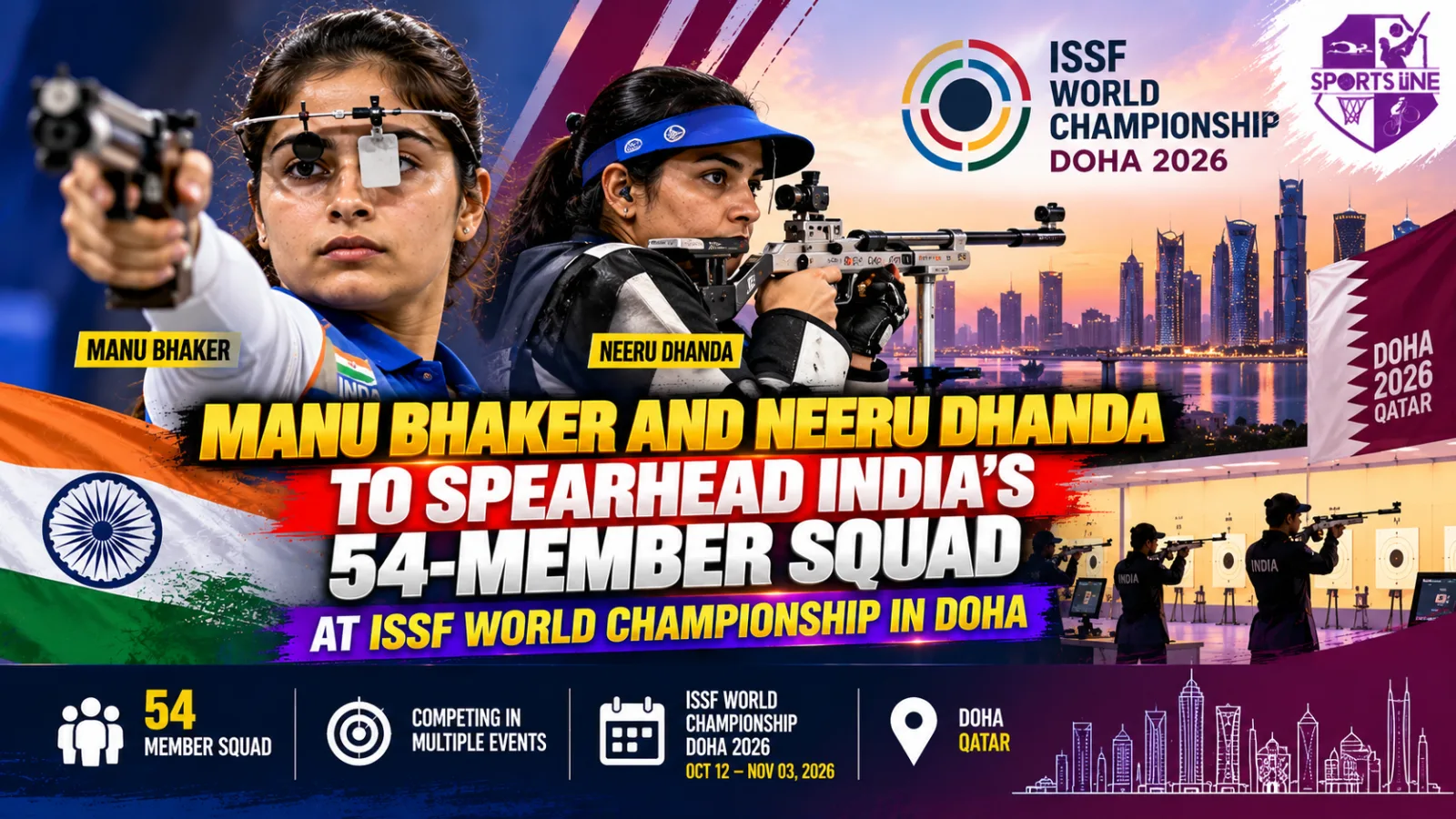
Two-time Olympic medallist Manu Bhaker and Asian Games standout Neeru Dhanda will lead India’s 54-member shooting squad at the ISSF World Championship in Doha, Qatar, scheduled from November 1 to 14, 2026. The championship opens the shooting qualification pathway for the Los Angeles 2028 Olympic Games, with 36 quota places available across the 12 Olympic events.
India will field 35 athletes in Olympic disciplines and 19 in non-Olympic categories. The squad covers rifle, pistol and shotgun events, with Bhaker entered in two pistol events and Dhanda leading the women’s trap challenge following a strong Asian Games campaign.
Bhaker is listed for the women’s 10m air pistol and 25m pistol events. She will be joined in the 10m air pistol by Sainyam Vij and Suruchi Singh, while Esha Singh and Divya TS complete the women’s 25m pistol group. Suruchi and Kamaljeet Sohlot were also among the Indian athletes highlighted for their recent Asian Games success in the mixed 10m air pistol event.
Dhanda will compete in women’s trap alongside Manisha Keer and Pragati Dubey. She is also paired with Zoravar Singh Sandhu in the trap mixed team event. Dhanda heads to Doha after an Asian Games campaign that included two trap gold medals and a silver, according to published reports.
The rifle squad features Asian Games silver medallists Elavenil Valarivan and Himanshu Dhillon in the 10m air rifle disciplines. Aishwary Pratap Singh Tomar will compete in men’s 50m rifle three positions, while Olympian Anjum Moudgil is named in the women’s event. Paris 2024 bronze medallist Swapnil Kusale is included in the non-Olympic men’s 50m rifle prone competition.
The Doha championship is a major early opportunity in the qualification cycle for Los Angeles 2028. A total of 36 quota places are available, with three offered in each of the 12 Olympic shooting events. However, a quota is awarded to a country rather than automatically to the athlete who earns it, leaving the final Olympic selection to the national federation.
That distinction means strong results in Doha can help India secure places for the Games, but individual athletes will still need to meet the federation’s selection requirements. The championship is therefore important both for immediate results and for positioning India’s shooting programme early in the qualification process.
The event brings together Olympic and non-Olympic disciplines. India’s 35 shooters in Olympic events will cover all 12 disciplines, while another 19 athletes will contest non-Olympic categories. The broader entry allows the team to compete for medals and experience across a wider set of shooting events alongside the quota race.
In men’s 10m air rifle, India has named Parth Mane, Himanshu Dhillon and Paarth Makhija. The women’s team comprises Shambhavi Kshirsagar, Sonam Maskar and Elavenil Valarivan. The men’s 10m air pistol group includes Ravin Kumar, Jaypal Malviya and Kamaljeet Sohlot.
In shotgun events, the men’s skeet squad includes Mairaj Ahmad Khan, Bhavtegh Singh Gill and Anant Jeet Singh Naruka. The women’s skeet team comprises Parinaaz Dhaliwal, Ganemat Sekhon and Raiza Dhillon. Men’s trap selections are Zoravar Singh Sandhu, Vivaan Kapoor and Udaivir Singh Jaijee.
The non-Olympic entries include Saurabh Chaudhary in men’s 50m pistol and Sift Kaur Samra in women’s 50m rifle prone, alongside other specialist competitors. The selection of athletes across these events gives India representation beyond the Olympic quota disciplines.
One notable name missing from the announced squad is Sarabjot Singh, the Paris 2024 Olympic bronze medallist. His absence is a feature of the final selection, though the available reports do not provide a specific reason for the omission.
Indian shooters began a preparatory camp at the Dr Karni Singh Shooting Range in New Delhi on October 22. Training dates were staggered by discipline, with several rifle, pistol and skeet groups scheduled through October 29, the 50m rifle and women’s 25m pistol groups through October 31, and the trap contingent joining from October 28.
With the championship beginning on November 1, the Indian team will now look to turn its preparation into qualification places and competitive results. For Bhaker, Dhanda and the wider squad, Doha represents the first major opportunity in the Los Angeles cycle to put India in a strong position for 2028.
