
Key points
- Former India all-rounder Irfan Pathan criticised the decision to play Bhuvneshwar Kumar in the recent five-match T20I series against New Zealand.
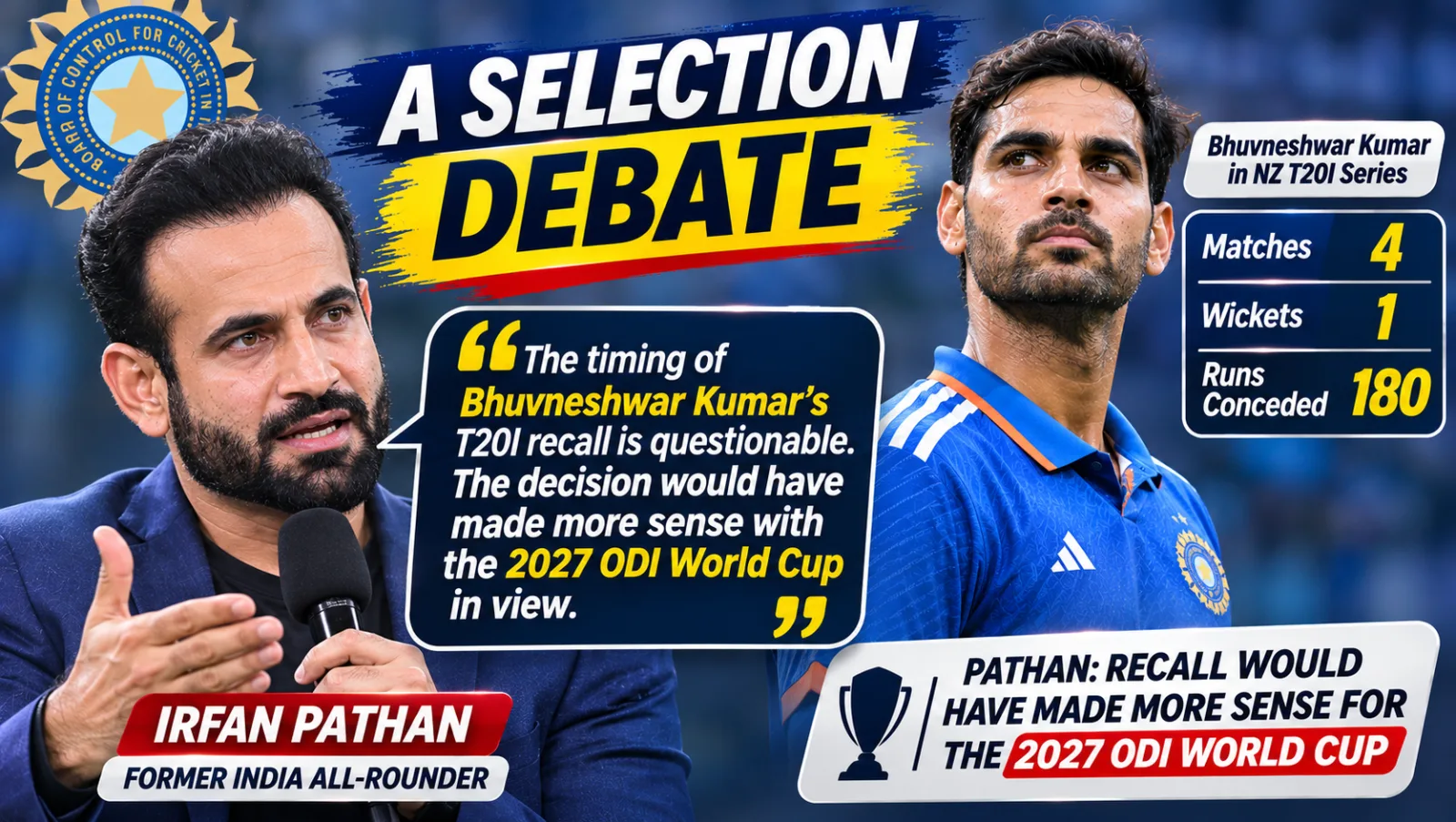
- Bhuvneshwar took one wicket and conceded 180 runs across four matches in the series.
- Pathan's central argument was about the timing and format of the recall, not a denial of Bhuvneshwar's bowling ability.
- Pathan said selecting Bhuvneshwar would have made more sense if the immediate objective had been preparation for the 2027 ODI World Cup.
- India won the first three T20Is against New Zealand before losing the final two, with the series ending 3-2.
- Bhuvneshwar returned to India's T20I side after an absence of around four years; his last appearance before the recall was in November 2022.
Former India all-rounder Irfan Pathan has questioned the decision to include Bhuvneshwar Kumar in India's recent T20I series against New Zealand, describing the selection as a mistake in the context of the team's preparation timeline. Bhuvneshwar returned to the national side after an absence of around four years, but finished the five-match series with one wicket and 180 runs conceded in four appearances.
Pathan questions the timing of the recall
Pathan, a member of India's 2007 T20 World Cup-winning team, argued that the selectors needed to consider which global event the team was preparing for when bringing the experienced seamer back into the T20I set-up. In comments reported after the New Zealand series, he said the selection would have been more understandable if the immediate focus had been the 2027 ODI World Cup.
His criticism centred on the timing of the decision rather than Bhuvneshwar's ability. Pathan acknowledged that the Meerut-born bowler is a good and experienced player, but questioned the value of using a place in the T20I side for him when the next T20 World Cup was not close.
Pathan's argument also raised the question of whether the series could have been used to give international exposure to younger fast bowlers. With India continuing to build options across formats, the balance between experience and long-term development remains part of the selection discussion.
Bhuvneshwar's numbers in the series
Bhuvneshwar played four of the five T20Is against New Zealand and took one wicket while conceding 180 runs. The figures gave Pathan's comments a statistical context, although a short series sample does not by itself measure a bowler's overall value or explain every selection decision.
India won the first three matches and secured the series before New Zealand responded by taking the final two games. The 3-2 result meant the visitors finished strongly, even though India had already taken an unassailable lead.
Bhuvneshwar's return was a notable development before the series began. He had not represented India since November 2022, when he last played against New Zealand. The recall ended a gap of roughly four years and brought an experienced swing bowler back into the national T20I set-up.
Format and World Cup planning at the centre of debate
Pathan's comments focused on the distinction between India's immediate T20I requirements and preparation for the 50-over World Cup in 2027. His view was that a recall for an upcoming ODI campaign could have had a clearer planning rationale, while the T20I selection appeared less urgent with the next global tournament in the shortest format still some way off.
The debate is not simply about one player's figures. Selectors must weigh recent form, experience, role requirements, fitness and the development of younger options. A veteran bowler can offer control and knowledge, but a series can also provide a chance to assess players who may be part of the team's longer-term plans.
Bhuvneshwar's case has attracted attention because his return followed strong domestic and franchise performances. The selectors' decision to bring him back reflected an assessment that his experience and skills could still be useful, while Pathan's comments show that the timing and format of that opportunity remain open to discussion.
India's series win and New Zealand's late response
India began the five-match contest with three consecutive victories, taking the series beyond New Zealand's reach before the final two games. New Zealand then won the fourth and fifth T20Is, finishing the tour leg with momentum despite losing the series 3-2.
The final two results also provided a reminder that a series outcome and individual player assessments can be considered separately. India had already secured the trophy, but the closing matches and the performances across the full campaign continued to shape discussion around selection and roles.
For Bhuvneshwar, the series marked a return to international cricket after a long break. For Pathan, the question was whether that return needed to happen in this particular format and at this stage of the calendar. The disagreement is about squad planning and the use of international opportunities, not a claim that the veteran seamer lacks the skill to contribute.
What the debate means for the next selection decisions
India's upcoming calendar includes commitments in both white-ball formats, with the 2027 ODI World Cup forming a major medium-term target. The selectors will have to decide how to divide opportunities between established players and emerging fast bowlers as they build depth for different conditions and roles.
Pathan's intervention adds another voice to the discussion around Bhuvneshwar's place in the national set-up. The bowler's experience remains part of the case for his selection, while the numbers from the New Zealand T20Is and the timing argument provide the basis for questioning whether this was the right series for his comeback.
The wider takeaway is that a recall after a long absence is only the beginning of the assessment. The role assigned to a returning player, the format in which he is used and the opportunities available to younger teammates will all remain relevant as India plan for the next cycle of international tournaments.
Frequently asked questions
Who criticised Bhuvneshwar Kumar's selection for the New Zealand T20I series?
Former India all-rounder Irfan Pathan, a member of India's 2007 T20 World Cup-winning team, questioned the decision to play Bhuvneshwar Kumar in the five-match T20I series against New Zealand. Pathan focused on the timing of the recall and the opportunity it provided to other bowlers.
How many wickets did Bhuvneshwar Kumar take against New Zealand in the T20I series?
Bhuvneshwar Kumar took one wicket in four matches during the five-match T20I series against New Zealand. He conceded 180 runs across those appearances, figures that formed the statistical backdrop to Irfan Pathan's criticism of the selection decision.
What did Irfan Pathan say about Bhuvneshwar Kumar's selection?
Pathan said the selectors made a mistake by playing Bhuvneshwar in this particular T20I series. He argued that the selection would have been easier to understand if the team had been preparing for the 2027 ODI World Cup, which was closer than the next T20 World Cup.
Did Irfan Pathan question Bhuvneshwar Kumar's bowling ability?
No. Pathan acknowledged that Bhuvneshwar is a good and experienced bowler. His criticism was directed at the timing and purpose of the recall, rather than the seamer's skill or overall contribution to Indian cricket.
What was the result of India's T20I series against New Zealand?
India won the five-match T20I series 3-2. The hosts took the first three matches to seal the series, while New Zealand won the fourth and fifth games to finish with two victories.
When did Bhuvneshwar Kumar last play for India before his recall?
Bhuvneshwar's previous international appearance before his return came in a T20I against New Zealand in November 2022. His selection for the 2026 series therefore ended an absence of around four years from the national side.