Published:
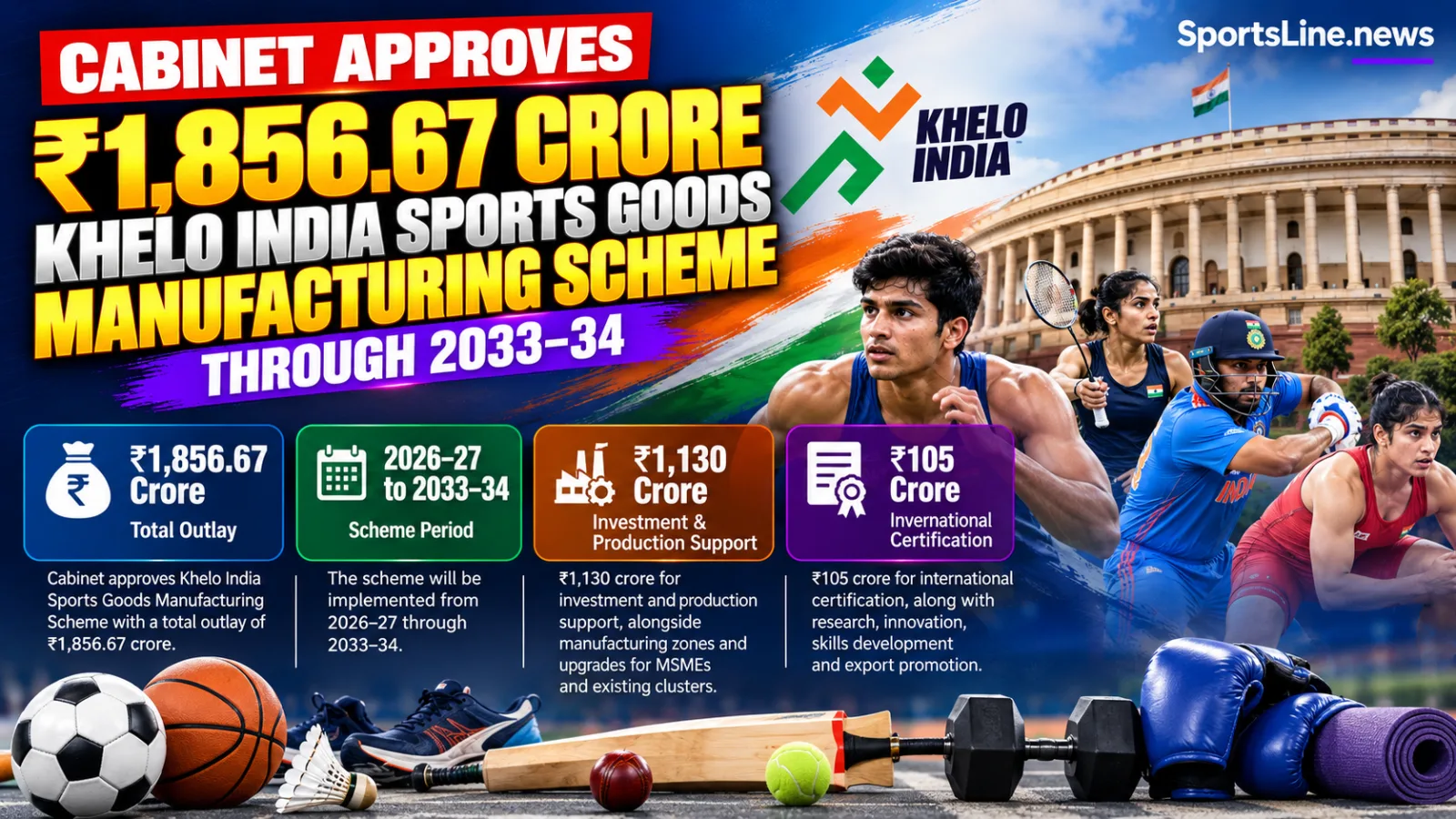
The programme combines investment incentives with support for manufacturing clusters, quality certification, research, innovation, skills and export promotion. According to the government’s announcement, the aim is to build a more integrated sports goods manufacturing ecosystem rather than focus only on increasing production volumes.
A combined ₹1,130 crore is earmarked for anchor investment support and turnover-linked support. The anchor component is intended to encourage domestic and international manufacturers, brands and retail chains to establish facilities in designated zones. Turnover-linked assistance is intended to encourage higher production, capacity expansion and sustained manufacturing growth.
The scheme envisages dedicated Sports Goods Manufacturing Zones that bring manufacturers together with suppliers, testing facilities, design and prototyping centres, and ancillary enterprises. The government says the zones will be developed in convergence with existing industrial infrastructure under the BHAVYA Scheme and NICDC Industrial Parks.
By clustering different parts of the supply chain, the programme aims to improve industry linkages and operational efficiency. The government expects this structure to attract investment, increase domestic value addition and reduce dependence on imported sports goods. These are intended outcomes of the scheme; the actual effect will depend on implementation, investment commitments and the ability of manufacturers to compete on price and quality.
Micro, small and medium enterprises are a major focus of the plan. The scheme proposes assistance to upgrade existing sports goods manufacturing clusters, including common facilities and shared infrastructure. That could help smaller manufacturers access facilities that may be difficult for individual businesses to finance on their own.
The government’s wider scheme note identifies established manufacturing clusters such as Jalandhar in Punjab and Meerut in Uttar Pradesh as part of India’s existing base. The new support is intended to strengthen current enterprises while creating scope for more integrated production and supplier networks.
For smaller firms, access to improved facilities is only one part of competitiveness. Product reliability, production costs, design, delivery schedules and the ability to meet international specifications also matter. The scheme’s emphasis on certification, technology and skills indicates an attempt to address several of those requirements together.
The Cabinet-approved programme allocates ₹105 crore to support manufacturers in obtaining and renewing certifications from International Sports Federations. Such certifications can be important for products used in organised competition, where equipment must meet sport-specific rules and technical standards.
The scheme also provides for Centres of Excellence at leading educational and research institutions. Areas identified for research include sports equipment, material sciences, protective gear and advanced manufacturing technologies. Research and development will be encouraged through convergence with the Anusandhan National Research Foundation.
Start-ups are also expected to receive support to develop, test, validate and commercialise new technologies, processes and products. The approach links manufacturing policy with product development: the goal is not only to produce more goods, but also to improve the quality and technical capability of what Indian manufacturers can offer.
Skill development initiatives are to be aligned with industry needs and implemented with the Ministry of Skill Development and Entrepreneurship and relevant industry stakeholders. The scheme also includes branding, outreach and market-development measures intended to improve the visibility of Indian sports goods and help manufacturers reach international buyers, drawing on the Export Promotion Mission.
The government expects the scheme to attract investment, create employment opportunities across the value chain and strengthen exports. It also says higher domestic manufacturing capacity and internationally certified equipment could support India’s sports sector and athlete development programmes, complementing initiatives such as Khelo India and Fit India.
The scale of the financial outlay signals a long-term policy push, but the scheme’s results will need to be assessed through implementation milestones: whether manufacturing zones are established, whether firms invest and expand, whether product certification increases, and whether Indian goods gain access to more markets.
The approved timeline extends to 2033–34, giving the programme several years to build capacity across investment, infrastructure, technology and market access. The next important details for manufacturers will be the operational guidelines, eligibility conditions, application processes and the schedule for implementing individual support components.
For India’s sports ecosystem, the policy connects athlete development with the industrial capacity behind sporting equipment. If implementation delivers the intended links between manufacturing, research, certification and exports, the scheme could create opportunities for existing producers and new businesses while improving the availability of quality sports goods made in India.
