
Key points
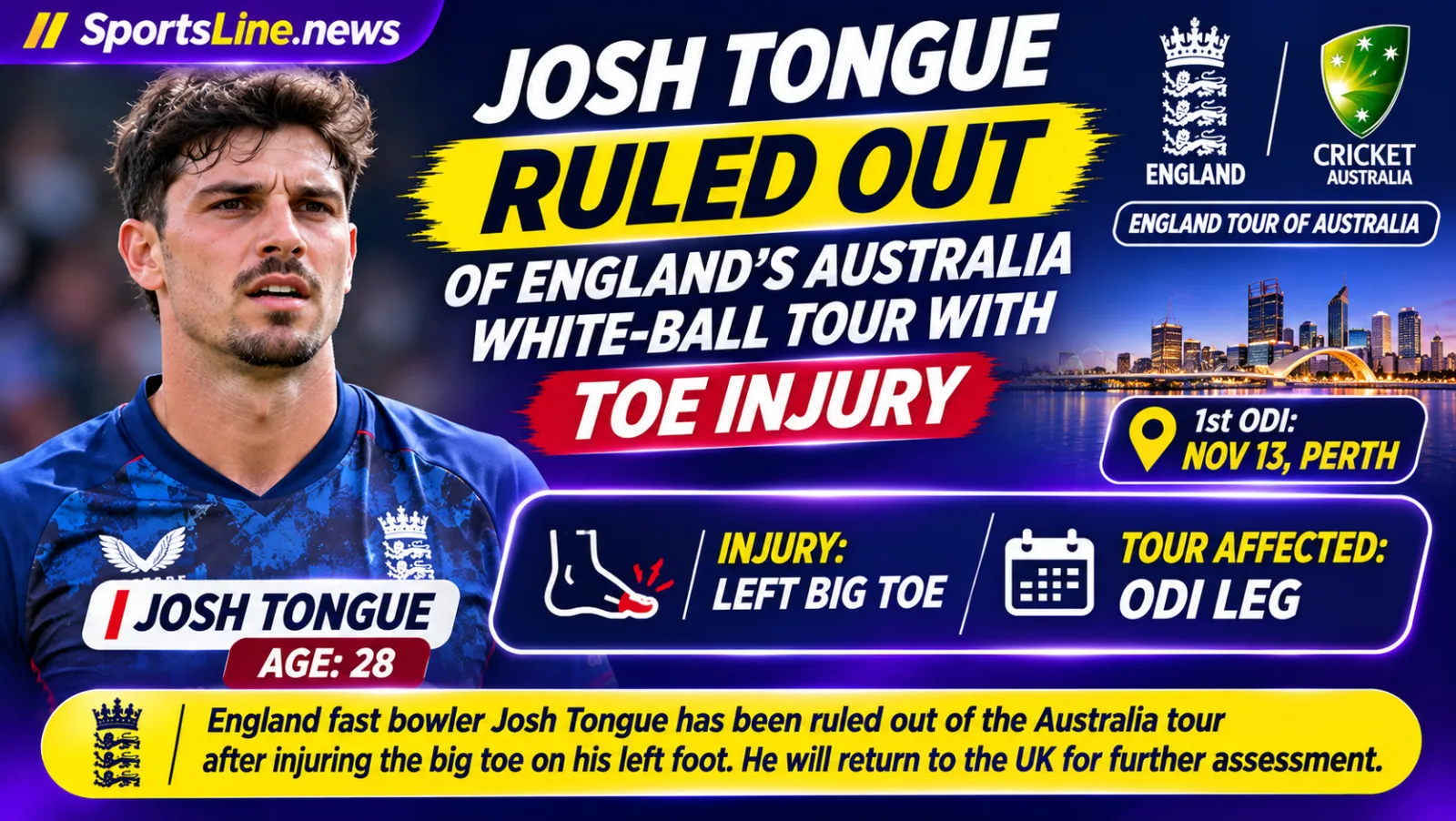
- England confirmed on November 7, 2026, that Josh Tongue had been ruled out of the white-ball tour of Australia because of a left big toe injury.
- The 28-year-old fast bowler will return to the United Kingdom for further assessment; no recovery timeline was announced.
- Tongue had been selected for the ODI leg of the tour and was not part of England’s T20I squad.
- England’s three-match ODI series against Australia begins in Perth on November 13, followed by matches in Adelaide on November 15 and Hobart on November 18.
- Tongue did not play in England’s warm-up match against Western Australia, which England won by 92 runs in Perth.
- England had not announced a replacement for Tongue in the immediate aftermath of the withdrawal.
- Jofra Archer and Adil Rashid took three and four wickets respectively in the warm-up victory over Western Australia.
England have suffered a fast-bowling setback ahead of their white-ball tour of Australia, with Josh Tongue ruled out after sustaining an injury to the big toe on his left foot. The England and Wales Cricket Board confirmed the withdrawal on November 7, stating that the 28-year-old will return to the United Kingdom for further assessment.
Tongue had travelled to Australia as part of England’s ODI squad but was unavailable for the team’s 92-run warm-up victory over Western Australia in Perth. His withdrawal leaves England without one of the seam options selected for the three-match one-day series, which begins on November 13.
Injury ends Tongue’s Australia assignment
The ECB announcement identified the injury as affecting Tongue’s left big toe. The fast bowler is to return to the UK, where further medical assessment will determine the extent of the problem and the next steps in his recovery. No specific return date or rehabilitation timeline was provided in the announcement.
Tongue was selected for the ODI leg of the Australia tour and was not included in England’s T20I squad. His absence therefore affects the one-day group preparing for the opening match in Perth. Reports following the ECB announcement said England had not named a replacement at that stage.
The injury comes as England prepare for a demanding schedule across formats. The Australia assignment consists of three ODIs and five T20 internationals, before the team moves on to its subsequent international commitments. Tongue’s immediate priority will be the assessment of the toe injury after returning home.
ODI series begins in Perth on November 13
England and Australia are scheduled to begin their three-match ODI series at Perth on Friday, November 13. The second match is set for Adelaide on November 15, with the third and final ODI to be played in Hobart on November 18.
Tongue’s absence was confirmed shortly after England’s warm-up match against Western Australia. England won that contest by 92 runs, with Jofra Archer taking 3/34 and Adil Rashid claiming 4/35 as the hosts were dismissed for 159. The result offered England useful preparation, although the squad will now have to adjust its bowling plans without Tongue.
Archer’s return to the side was a positive feature of the practice match. Rashid also made an impact with the ball, taking four wickets, while England’s overall bowling effort defended the total successfully. The performance gives the team options to consider as it finalises its combination for the first ODI.
England face a selection decision in the pace department
Tongue’s withdrawal creates an opening in the ODI bowling group, although England had not publicly confirmed a replacement when the injury news emerged. The existing squad includes several seam-bowling options, and the team management will need to decide how to distribute the workload across the series.
The tour is an important opportunity for England to test their white-ball combinations in Australian conditions. The ODI leg comes first, with the five-match T20I series to follow. Tongue’s original selection for the one-day matches indicated that he was part of the plans for that portion of the trip; his injury now requires a change before the series begins.
For Tongue, the immediate focus is on the assessment in the UK rather than a confirmed return date. Until the medical review establishes the severity of the injury, England have not provided a timetable for his recovery. The team’s preparations will continue in Australia ahead of the first ODI in Perth.
What happens next
England are due to face Australia in Perth on November 13, with further ODIs in Adelaide and Hobart. The ECB’s next update on Tongue is expected after he undergoes further assessment in the UK. Any decision on a replacement or a possible return to action will depend on the team’s selection plans and the outcome of that assessment.
Frequently asked questions
Why has Josh Tongue been ruled out of England’s Australia tour?
Tongue has been ruled out because of an injury to the big toe on his left foot. The ECB confirmed the news on November 7, 2026, and said the fast bowler would return to the United Kingdom for further assessment.
Will Josh Tongue play in the England vs Australia ODI series?
No. Tongue has been ruled out of the white-ball tour and will miss the three-match ODI series against Australia. The first ODI is scheduled for Perth on November 13, followed by matches in Adelaide on November 15 and Hobart on November 18.
When will Josh Tongue return from his toe injury?
England have not announced a return date for Tongue. He is due to return to the UK for further assessment of the left big toe injury, and the extent of the problem and recovery plan will be clearer after that medical review.
Was Josh Tongue selected for England’s T20I series in Australia?
No. Tongue had been selected for the ODI leg of the Australia tour and was not included in England’s T20I squad. His withdrawal therefore affects the one-day group ahead of the three-match series beginning in Perth.
Have England named a replacement for Josh Tongue?
England had not announced a replacement in the immediate aftermath of Tongue’s withdrawal on November 7. The existing ODI squad contains other bowling options, but the ECB had not confirmed a change to the group at that stage.