
Key points
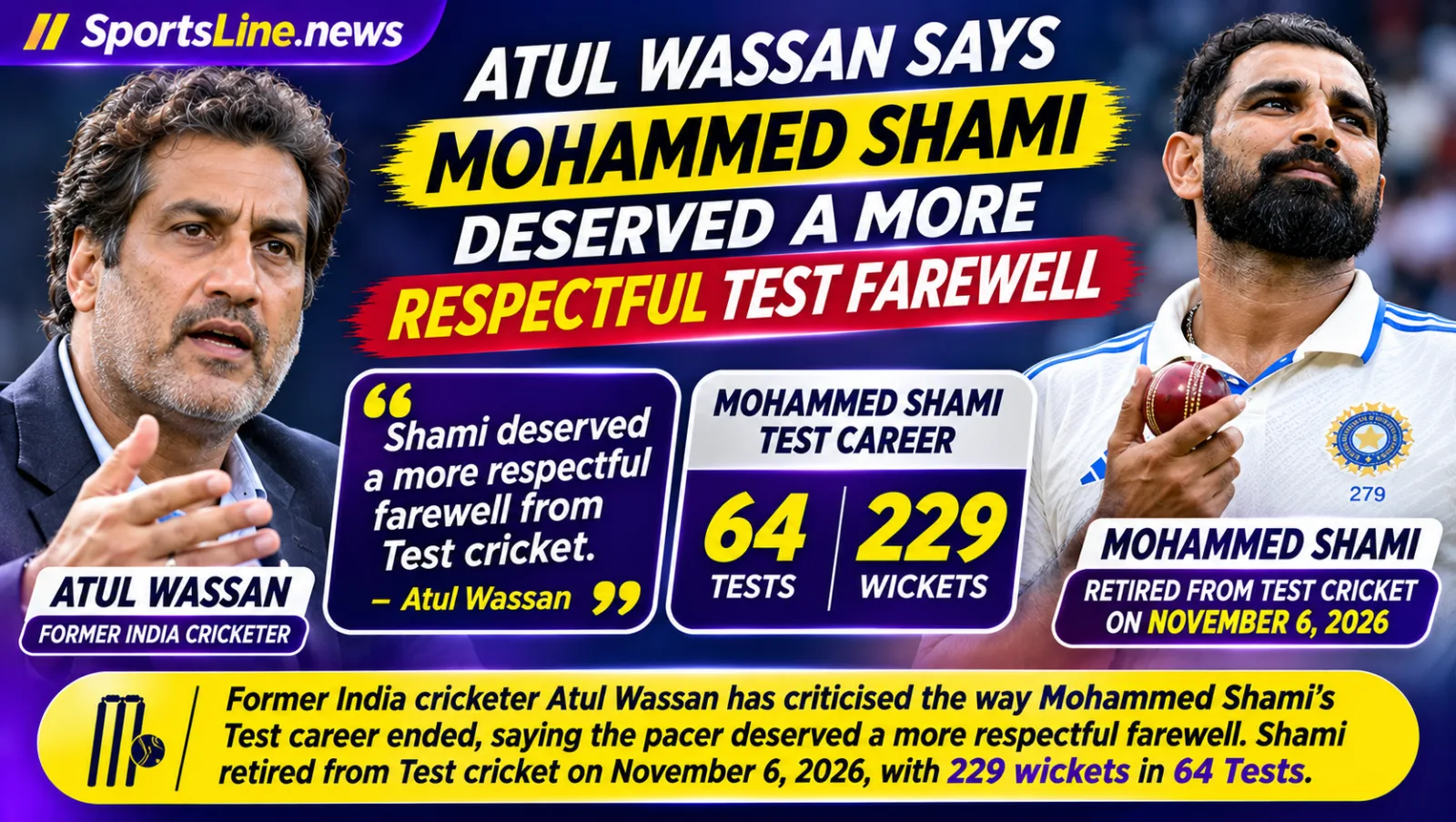
- Atul Wassan said Mohammed Shami deserved a more respectful farewell after announcing his retirement from Test cricket on November 6, 2026.
- Shami’s Test career ended after 64 matches and 229 wickets, with his final appearance coming in the 2023 World Test Championship final against Australia.
- Wassan said Shami had continued working towards a comeback through domestic cricket, including playing Ranji Trophy matches and performing well.
- The former India cricketer argued that Indian cricket has a bias against age and felt Shami could have served the team for another couple of seasons.
- Wassan said Shami’s return to the Test side appeared difficult with Gautam Gambhir as head coach, while emphasising that his comments were his assessment of the situation.
- Wassan acknowledged the selectors’ need to develop younger fast bowlers ahead of future global events but said senior players deserved respect and consideration.
- Shami has retired from Test cricket but intends to continue playing white-ball formats.
Former India cricketer Atul Wassan believes Mohammed Shami deserved a more respectful farewell to his Test career, saying the veteran fast bowler had worked hard for a comeback and could have continued serving India for another couple of seasons. Wassan’s comments followed Shami’s announcement of retirement from Test cricket on November 6, 2026, bringing a 13-year international career in the format to a close.
Shami finished with 229 wickets in 64 Tests. His last appearance came in the 2023 World Test Championship final against Australia. Although he continued to play domestic cricket and pursue a return to the national side, he did not feature again in a Test for India. Wassan said the manner in which the career ended was disappointing given the fast bowler’s contribution and resilience.
Wassan says Shami deserved a dignified send-off
Speaking about the retirement, Wassan praised Shami’s talent and determination, while expressing sadness that the pacer’s hoped-for return did not happen. He said Shami had continued doing the hard work in domestic cricket, including turning out in the Ranji Trophy, with the hope that his career could end on a more positive note.
Wassan referred to Bhuvneshwar Kumar’s return to the national setup as an example of the kind of late-career opportunity Shami might have hoped for. His argument was not that selection should be guaranteed, but that a senior player with Shami’s record deserved to be considered on cricketing merit and treated with respect as his career approached its conclusion.
The former India cricketer said Shami’s performances and recovery from injury made him believe the fast bowler could have offered another couple of seasons. Wassan’s view was that India might still have found use for Shami, particularly when experience becomes important in major tournaments.
Age bias and the selection debate
Wassan also raised the issue of what he described as an age bias in Indian cricket. He argued that the focus on building for the future should not automatically close the door on experienced players who remain capable of contributing. In Shami’s case, he felt the combination of his experience, past performances and efforts to regain fitness warranted further consideration.
He also suggested that Shami’s prospects of a Test comeback were limited under head coach Gautam Gambhir. That was Wassan’s assessment of the selection environment rather than an official explanation from the team management or selectors. Neither the retirement announcement nor the comments establish that a particular individual made the decision for Shami.
Wassan acknowledged that selectors have a responsibility to develop younger fast bowlers and build depth ahead of the next World Cup cycle. He said that process may require giving emerging players opportunities, even if some initially struggle. However, he argued that the transition should not come at the expense of basic respect for senior players who have delivered for India over many years.
Shami’s Test record and the unfinished comeback story
Shami’s 229 wickets in 64 Tests place him among India’s significant fast-bowling contributors in the format. His final Test was the World Test Championship final against Australia in June 2023, where he took two wickets in each innings. India lost that match by 209 runs, and Shami did not return to the Test side afterwards.
The fast bowler continued to feature in domestic cricket as he worked towards a possible international comeback. Wassan highlighted those efforts as evidence that Shami had not simply walked away from the challenge. The disappointment, in his view, came from the absence of an opportunity to make one more contribution in the Test side or to have a more ceremonial ending to his career.
Shami’s retirement announcement made clear that he was stepping away from the longest format, not from cricket altogether. He intends to continue playing white-ball cricket, leaving open the possibility of further appearances in limited-overs competitions. That means his career at the international level is not necessarily over, even though his Test chapter has ended.
A debate about transition and respect
Wassan’s remarks have added another perspective to the discussion around Shami’s retirement. The selectors must plan for the future and assess fast bowlers on fitness, form and suitability, but Wassan’s criticism centres on how a player with a substantial record is managed during that transition.
There is a distinction between earning a place in the team and receiving recognition for a career. Wassan’s comments focus on the latter as much as the former: he believes Shami’s service deserved a more dignified conclusion, even if the team ultimately chose to move in a different direction. The debate now sits alongside the tributes to a bowler who took 229 Test wickets and remains available in white-ball cricket.
Frequently asked questions
What did Atul Wassan say about Mohammed Shami’s retirement?
Wassan said Shami deserved a more respectful farewell after his Test retirement. He praised the fast bowler’s talent and resilience, noted his efforts to return through domestic cricket, and felt India could have used his experience for another couple of seasons.
How many Test wickets did Mohammed Shami take?
Shami finished his Test career with 229 wickets from 64 matches. His final appearance came in the 2023 World Test Championship final against Australia. He announced his retirement from the longest format on November 6, 2026.
Why did Atul Wassan raise the issue of age bias?
Wassan argued that Indian cricket can be biased against older players and said experience should not be discounted automatically. He felt Shami’s recovery from injuries and efforts in domestic cricket could have justified another opportunity or two in the Test side.
Did Atul Wassan blame Gautam Gambhir for Shami’s retirement?
Wassan said he believed a Test comeback looked difficult with Gautam Gambhir as head coach. This was Wassan’s assessment of the situation, not an official explanation from the team management or selectors for Shami’s retirement.
Has Mohammed Shami retired from all forms of cricket?
No. Shami has retired from Test cricket but intends to continue playing white-ball formats. His Test career ended with 229 wickets in 64 matches, while his future in limited-overs cricket remains separate from that decision.