
Key points
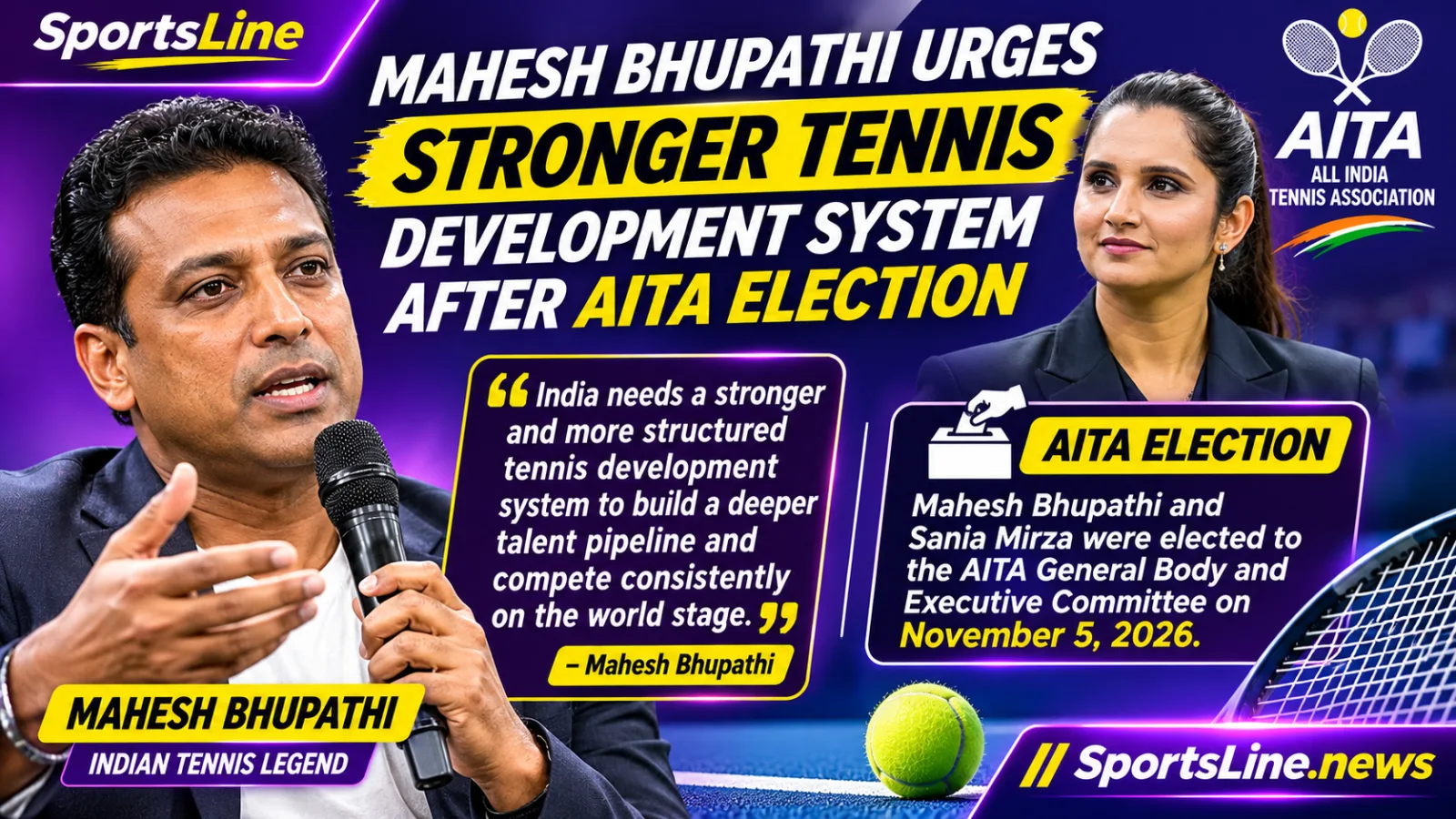
- Mahesh Bhupathi called for a robust system to develop Indian tennis players, saying international tournaments are useful only when domestic players can capitalise on them.
- Bhupathi and Sania Mirza were elected to the All India Tennis Association General Body as Sportspersons of Outstanding Merit representatives and also joined its Executive Committee on November 5, 2026.
- Bhupathi said Indian players need a structure that helps them compete in major tournaments, earn ranking points and progress to the global level.
- Bhupathi cited the Chennai Open as an important early opportunity, saying he and Leander Paes won the tournament five times and used it as a gateway to the international stage.
- He also pointed to Sania Mirza's first WTA event win in Hyderabad as an example of the value of home tournaments when local players can succeed.
- Leander Paes called for the AITA to be professionalised and for administrative fragmentation to be addressed.
- Paes said tennis investment should reach rural India as well as metropolitan centres, creating pathways for rural talent to access higher-level training.
Mahesh Bhupathi has called for a robust player-development system in Indian tennis, arguing that the country must create a pathway through which domestic players can turn home tournaments into international progress. His comments came as Bhupathi and Sania Mirza secured places in the All India Tennis Association (AITA) General Body and Executive Committee on Thursday, November 5, 2026.
The former doubles world number one said international tournaments hosted in India would have limited value if local players were unable to compete successfully, earn ranking points and move towards the highest levels of the sport. Leander Paes, meanwhile, called for professionalisation of the AITA and greater investment in tennis across rural and urban areas.
Bhupathi puts player development at the centre
Bhupathi's central argument was that India needs a system capable of producing players who can take advantage of the opportunities available at home. He said the country must first build the structure needed to develop competitors who can win matches at international events and use those results to advance their careers.
He questioned the purpose of staging numerous tournaments if Indian players could not make meaningful progress at them. In his view, the value of hosting an event should be measured not simply by its presence on the calendar, but by whether domestic competitors can earn points and use the competition as a step towards the global circuit.
Bhupathi used the Chennai Open as a personal example. He recalled that he and Leander Paes won the tournament five times and described it as their first ATP title and a gateway to the international stage. He also cited Sania Mirza's first WTA event victory in Hyderabad, arguing that home tournaments can become important career milestones when Indian players are prepared to succeed in them.
AITA roles for Bhupathi and Sania Mirza
The comments followed an important development in Indian tennis administration. According to Asianet Newsable's ANI-syndicated report, Bhupathi and Mirza were elected to the AITA General Body as representatives of Sportspersons of Outstanding Merit. Both were also elected to the association's Executive Committee on November 5.
Their entry into the federation's governing structures gives two prominent former players a formal role within the organisation. Bhupathi's public emphasis, as reflected in the report, is on establishing a development structure that can help Indian players make the most of international competition hosted in the country.
Bhupathi is one of India's most successful tennis players. The report records 12 Grand Slam titles across men's doubles and mixed doubles: four in men's doubles and eight in mixed doubles. His long partnership with Paes also produced multiple major titles and helped establish the pair among the leading doubles teams of their era.
Paes calls for professionalisation and wider investment
Paes added an organisational and access-focused dimension to the discussion. He said professionalising the AITA was imperative and pointed to fragmentation within the administration as an obstacle to a globally competitive sport. His comments placed governance reform alongside the need to build a broader player base.
He also called for tennis funding to reach beyond major metropolitan centres. In his view, investment should extend across rural India as well as cities, with opportunities for players from smaller communities to move to metropolitan centres and receive the coaching and development support needed to improve.
The emphasis on rural access widens the development question beyond the performance of established players. A sustainable national system would need to identify talent in different parts of the country and create a route through which promising players can access stronger training environments.
Why home tournaments need a player pathway
Bhupathi's examples underline the potential connection between hosting international events and developing domestic talent. The Chennai Open and Hyderabad WTA event provided opportunities on home soil, but his argument is that such opportunities deliver their full benefit only when Indian players can convert them into wins and ranking progress.
That requires more than adding tournaments to the calendar. It involves preparing players to compete at the required level and ensuring that the domestic structure can help them take the next steps after a breakthrough result. Paes's call for professional administration and investment across rural and urban India points to the wider support system that could make those opportunities accessible to more players.
With Bhupathi and Mirza now elected to AITA roles, and Paes publicly calling for administrative and investment reforms, the focus turns to whether the federation can translate these priorities into a consistent development pathway. The immediate message from the former champions is that Indian tennis needs a stronger system behind its players, so that hosting international events becomes a route to success rather than an end in itself.
Frequently asked questions
What did Mahesh Bhupathi say about the future of Indian tennis?
Bhupathi said India needs a robust and structured system to develop players. He argued that hosting international tournaments alone is not enough; Indian players must be equipped to use those events to compete successfully, earn ranking points and progress to the highest level.
Were Mahesh Bhupathi and Sania Mirza elected to the AITA Executive Committee?
Yes. Bhupathi and Sania Mirza were elected to the All India Tennis Association General Body as Sportspersons of Outstanding Merit representatives and were also elected to the association's Executive Committee on November 5, 2026.
Why does Mahesh Bhupathi believe tennis tournaments in India are important?
Bhupathi said tournaments matter when Indian players can take advantage of home conditions to win matches and earn ranking points. He cited the Chennai Open, where he and Leander Paes won five times, and Sania Mirza's first WTA event victory in Hyderabad.
What did Leander Paes demand from the All India Tennis Association?
Paes called for the AITA to be professionalised and for administrative fragmentation to be addressed. He also said investment in tennis should reach both rural India and metropolitan centres, allowing talent from rural areas to access better training opportunities.
How many Grand Slam titles did Mahesh Bhupathi win?
The Asianet Newsable report says Bhupathi won 12 Grand Slam titles during his career. The total comprised four men's doubles titles and eight mixed doubles titles. He was also a former doubles world number one and formed a successful partnership with Leander Paes.