
Key points
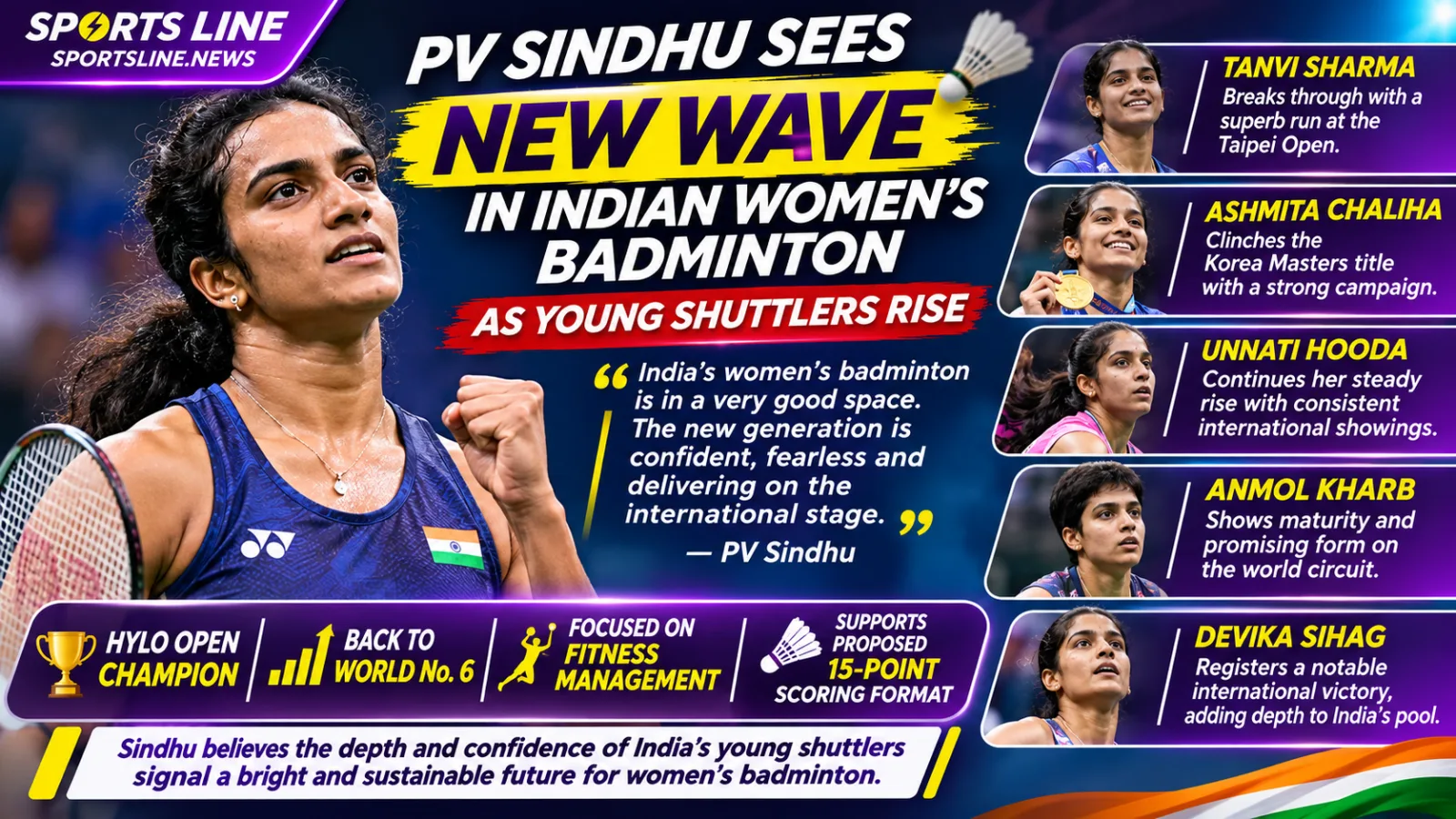
- PV Sindhu said four or five younger Indian women are now performing well and representing the country on the international badminton circuit.
- Sindhu named Ashmita Chaliha, Anmol Kharb, Unnati Hooda and Tanvi Sharma among the emerging players she is pleased to see progressing.
- Tanvi Sharma, 17, won the Taipei Open in August 2026, becoming the youngest champion in the tournament's history.
- Ashmita Chaliha won her maiden BWF World Tour title at the Korea Masters and later reached the French Open Super 750 quarterfinals.
- Unnati Hooda reached a career-best world ranking of No. 19 and the women's singles quarterfinals at the Asian Games.
- Sindhu won the 2026 HYLO Open, her second BWF World Tour title of the season, and returned to World No. 6.
Two-time Olympic medallist PV Sindhu believes Indian women's badminton is beginning to develop a stronger pipeline of young international performers. Reflecting on the progress of the next generation, Sindhu said the gap between her established generation and the juniors coming through had once been difficult to bridge, but a group of younger players is now making its presence felt on the senior circuit.
Speaking during a virtual media interaction, Sindhu welcomed the results being produced by Ashmita Chaliha, Anmol Kharb, Unnati Hooda and Tanvi Sharma. The Times of India also identified Devika Sihag among the Indian players who have recorded notable results in 2026.
Sindhu welcomes the younger generation
Sindhu said she was pleased to see several younger Indian women competing successfully and representing the country. She recalled a period when it was not clear which junior players would make the transition to the senior women's singles circuit.
Her assessment points to a gradual change in the depth of India's women's singles field. Rather than one player carrying the bulk of the international challenge, a number of younger shuttlers are now collecting results at different levels of the BWF World Tour and other international events.
Tanvi Sharma's Taipei Open title was one of the season's notable breakthroughs. The 17-year-old defeated Vietnam's Nguyen Thuy Linh 21-16, 21-16 in the final in August, becoming the youngest champion in the tournament's history. It was also India's first women's singles title at the Taipei Open since Saina Nehwal won it in 2008.
Ashmita Chaliha also made significant progress. She claimed her maiden BWF World Tour title at the Korea Masters, recovering after losing the opening game to beat China's Han Qianxi 14-21, 21-14, 21-14. She followed that achievement by defeating former world champion Akane Yamaguchi 21-19, 21-18 at the French Open to reach her first Super 750 quarterfinal.
Unnati, Anmol and Devika add to India's depth
Unnati Hooda reached a career-best world ranking of No. 19 and advanced to the women's singles quarterfinals at the Asian Games. Her campaign included a game won against Yamaguchi before she lost 16-21, 21-14, 17-21.
Anmol Kharb won the Turkiye International Challenge in October and then reached the semifinals of the HYLO Open. She defeated Unnati in the quarterfinals before her run ended against Sindhu, who won their match 21-13, 21-16.
Devika Sihag had already put India's name on the BWF World Tour title list in February by winning the Thailand Masters Super 300. Together, these results illustrate the range of progress across the group Sindhu was discussing. The players are at different stages of their careers, but their results provide more reference points for the future of Indian women's singles.
Sindhu's own season brings her back into the top six
The younger players' progress has coincided with a strong run from Sindhu herself. She won the HYLO Open in Germany, beating Denmark's Line Højmark Kjærsfeldt 21-12, 21-14 in 39 minutes. She completed the tournament without dropping a game, securing her second BWF World Tour title of 2026 after her Japan Open victory in July.
The HYLO Open win returned Sindhu to World No. 6, a position she had last held in 2022. She had also reached the French Open final the previous week, where she lost to South Korea's An Se-young. Sindhu said she was pleased with her progress but stressed that there was still room to improve.
A world champion in 2019 and a two-time Olympic medallist, Sindhu said she believed she could reach the top level again if she continued to take care of her body. Her comments linked her own career management with the longer-term demands of remaining competitive in a physically demanding sport.
Fitness, scheduling and the changing game
Sindhu described a more selective approach to her tournament schedule. She said her support team regularly assesses her condition and adjusts training or competition plans according to how she is feeling. The group includes strength and conditioning coach Wayne Lombard, physiotherapist and coach Irwansyah Adi Pratama.
She explained that playing tournaments back-to-back without being physically and mentally ready could affect performance and confidence. Taking time to recover, she said, was part of preparing to return stronger rather than entering events when she could not give her best.
Sindhu also discussed the challenge posed by An Se-young, whose win over her in the French Open final extended the South Korean's head-to-head lead to 11-0. Sindhu identified unforced errors and missed opportunities after taking the opening game as areas she needed to address before their next meeting.
Another adjustment on the horizon is badminton's proposed move to a 15-point scoring format from next year. Sindhu said the shorter games would leave less time to recover from a slow start. Players would need to be alert from the opening points and avoid giving away easy scores.
For Indian badminton, the season's emerging results offer a wider story than one champion's return to form. Sindhu's encouragement reflects a group of younger players beginning to build their own records, while her own results show that an experienced leading player remains part of the same evolving women's singles landscape.
Frequently asked questions
Which young Indian badminton players did PV Sindhu praise?
PV Sindhu highlighted Ashmita Chaliha, Anmol Kharb, Unnati Hooda and Tanvi Sharma during a virtual media interaction. The Times of India report also identifies Devika Sihag among the Indian women who have produced notable results during the 2026 season.
What did PV Sindhu say about the next generation of Indian women's badminton?
Sindhu said there had initially been a gap, with uncertainty about which junior players would progress to the senior women's circuit. She said she was now happy to see four or five young Indian players doing well and representing the country internationally.
What did Tanvi Sharma achieve at the 2026 Taipei Open?
Tanvi Sharma won the women's singles title at the Taipei Open in August 2026, beating Vietnam's Nguyen Thuy Linh 21-16, 21-16 in the final. At 17, she became the youngest champion in the tournament's history.
How did PV Sindhu return to the badminton world top six?
Sindhu won the 2026 HYLO Open in Germany, beating Denmark's Line Højmark Kjærsfeldt 21-12, 21-14 in the final. It was her second BWF World Tour title of the season after the Japan Open, and the result took her back to World No. 6.
What did Sindhu say about fitness and the proposed 15-point scoring format?
Sindhu said she and her support team assess her physical condition when choosing tournaments and training loads. She also said the proposed 15-point format would require players to be alert from the start because losing five or six points would represent a much larger part of a game.