
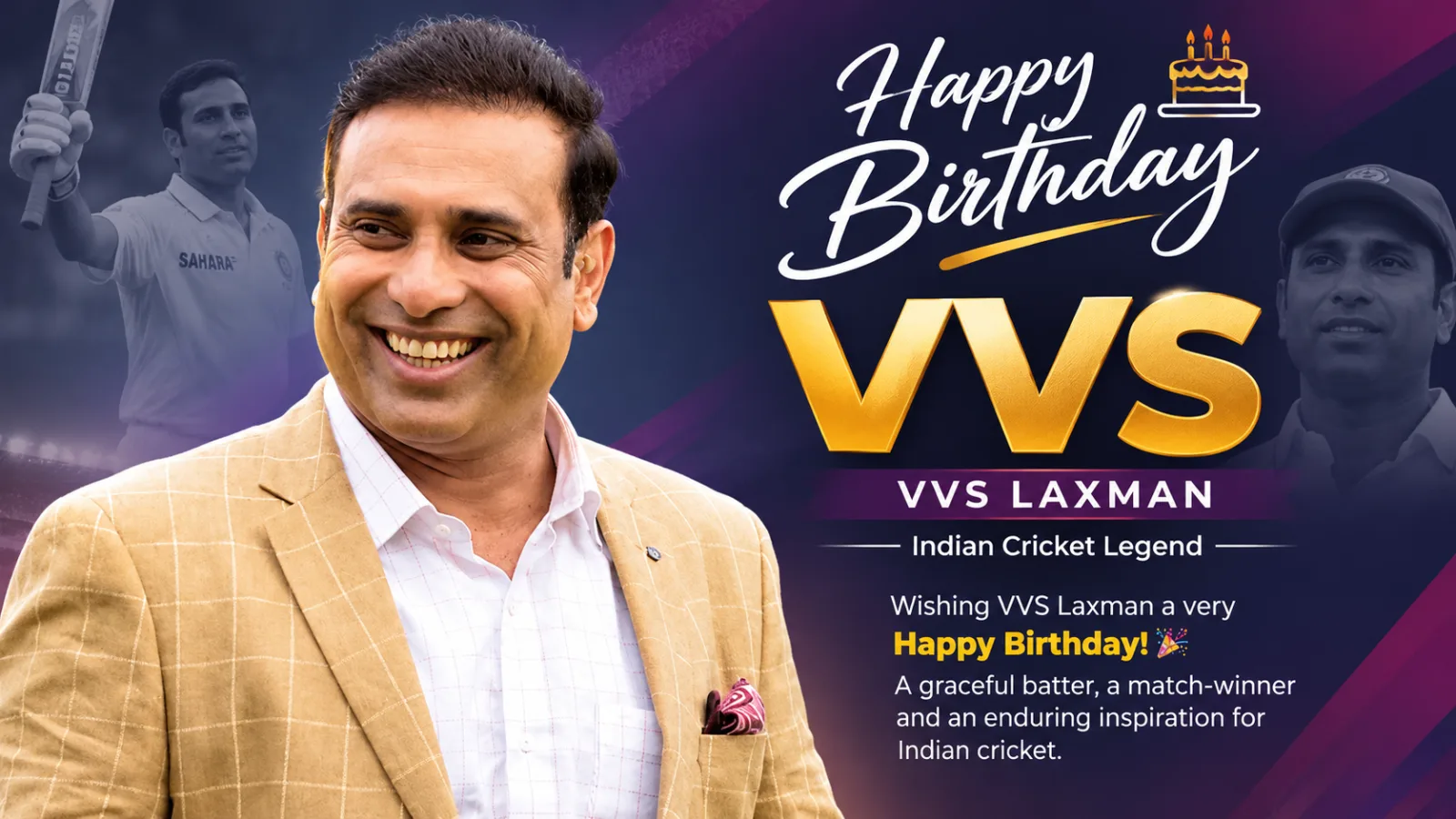
Key points
- Vangipurappu Venkata Sai Laxman was born on November 1, 1974, in Hyderabad and turns 52 on November 1, 2026.
- He made his Test debut against South Africa in Ahmedabad on November 20, 1996, and his ODI debut against Zimbabwe in Cuttack on April 9, 1998.
- Laxman scored 8,781 runs in 134 Tests at an average of 45.97, including 17 centuries and 56 half-centuries.
- He made 2,338 runs in 86 ODIs at an average of 30.76, with six centuries and 10 half-centuries.
- His celebrated 281 against Australia at Eden Gardens in March 2001 came in a 376-run partnership with Rahul Dravid and helped India win after being asked to follow on.
- Laxman received the Arjuna Award in 2001, was named Wisden Cricketer of the Year in 2002 and received the Padma Shri in 2011.
- After retirement in 2012, Laxman moved into commentary, mentoring and cricket administration, taking charge of the National Cricket Academy in 2021 and later leading the BCCI Centre of Excellence.
Vangipurappu Venkata Sai Laxman, affectionately known as VVS Laxman and remembered by many as India’s “Very Very Special” batter, turns 52 on November 1, 2026. Born in Hyderabad in 1974, Laxman became one of Indian cricket’s most admired Test specialists, a right-handed batter whose timing, wristwork and composure made him a distinctive presence in the middle order.
His career is inseparable from one extraordinary afternoon at Eden Gardens in 2001, when he scored 281 against Australia in a match that became a defining chapter in Indian cricket history. But Laxman’s legacy extends well beyond that innings: he scored more than 11,000 international runs, produced major performances against some of the strongest attacks of his era and later moved into the work of developing India’s next generation.
From Hyderabad talent to India debut
Laxman was born on November 1, 1974, in Hyderabad. He came through the Hyderabad cricket system and made his first-class debut for the state in the 1992-93 Ranji Trophy season. His domestic performances quickly established him as a batter with the patience and technique suited to the longer format.
His rise was underlined by a remarkable 1999-2000 Ranji Trophy campaign. BCCI’s career retrospective records that he scored 1,415 runs in nine matches at an average of 108.84, including eight centuries. He also made 353 against Karnataka in the semi-final, a first-class score that showcased his ability to build a long innings against quality bowling.
Laxman made his Test debut against South Africa at Ahmedabad on November 20, 1996. He made his ODI debut against Zimbabwe in Cuttack on April 9, 1998. In the early part of his international career he was moved around the batting order, including a period as an opener, before establishing himself as a specialist middle-order batter.
The unforgettable 281 at Eden Gardens
The defining moment arrived in March 2001, when Australia toured India with a formidable side and a long winning run. After losing the first Test in Mumbai, India were under severe pressure in Kolkata. Australia enforced the follow-on, leaving the home side facing the prospect of another defeat.
Laxman, promoted to No. 3, responded with 281 in the second innings. His partnership of 376 with Rahul Dravid transformed the match. The pair batted through the fourth day and shifted the pressure back onto Australia, before India completed a famous 171-run victory on the final day. The result ended Australia’s 16-match winning streak and remains one of Test cricket’s most celebrated comebacks.
The innings was not simply about its size. Laxman’s control, late wristwork and ability to find gaps against both pace and spin gave the innings its unmistakable character. The 281 was the highest Test score by an Indian at the time and became the performance most closely associated with his name.
Career numbers and performances against Australia
Laxman finished his Test career with 8,781 runs in 134 matches at an average of 45.97. His record includes 17 centuries, 56 half-centuries and a highest score of 281. In 86 ODIs, he scored 2,338 runs at an average of 30.76, with six centuries and 10 fifties. He was also a highly valued slip fielder, taking 135 catches in Test cricket.
Australia brought out some of his finest cricket. The BCCI’s annual report records 2,434 runs in 29 Tests against Australia at an average of 49.6, including six centuries. After Kolkata, he produced other significant performances against the same opponent, including a 148 in the 2003-04 Adelaide Test partnership with Dravid and an unbeaten 200 in Delhi in 2008.
His unbeaten 73 in the 2010 Mohali Test against Australia was another reminder of his temperament. With India close to defeat and the lower order alongside him, Laxman guided the chase to a one-wicket victory. He also played important innings in other conditions, including a 167 against Australia in Sydney in 2000 and a 103 against Sri Lanka in Colombo.
Honours and recognition
Laxman received the Arjuna Award in 2001 for his contribution to Indian sport. He was named one of Wisden’s five Cricketers of the Year in 2002, an international recognition of his performances. In 2011, he received the Padma Shri, one of India’s civilian honours.
His batting style made him stand apart from several contemporaries. He was not defined by power hitting; instead, his game relied on balance, touch, placement and the ability to use the pace of the ball. His wristy flicks through the leg side became a signature shot, while his calm approach made him especially valuable when India needed to rebuild or protect a difficult position.
Life after playing: building the next generation
Laxman announced his retirement from international cricket in August 2012. He subsequently worked in commentary, mentoring and cricket development. Before taking up a national role, he was associated with the Sunrisers Hyderabad IPL franchise and worked as a batting consultant with the Cricket Association of Bengal’s Vision 2020 programme.
In December 2021, he began his tenure as director of cricket at the National Cricket Academy in Bengaluru, succeeding Rahul Dravid. The institution later developed into the BCCI Centre of Excellence. In 2026, reports and interviews described Laxman as leading the Centre’s work on player development, high-performance support and widening pathways for domestic and emerging cricketers.
His post-playing contribution has focused on the systems behind the national team: preparing young players, supporting rehabilitation and skill development, and strengthening the route from age-group and domestic cricket to the senior level. It is a different role from the one he occupied at the crease, but it draws on the experience of a player who understood the demands of international cricket at the highest level.
A very special legacy
VVS Laxman’s career cannot be reduced to a single innings, even one as extraordinary as 281. His 134 Tests, 8,781 runs, 17 centuries and record against Australia tell the story of a consistent international batter. The defining images, however, remain the soft hands, the precise placement and the composure with which he changed the course of matches.
On his 52nd birthday, Indian cricket celebrates a player whose greatest contribution was often made when the situation looked difficult. From Hyderabad’s domestic grounds to the unforgettable afternoon at Eden Gardens and his continuing work at the Centre of Excellence, Laxman’s journey reflects a lasting connection with the game. Happy birthday to one of India’s Very Very Special cricketers.
Sources
- BCCI – Laxman’s career highlights
- ICC – VVS Laxman player profile and career biography
- BCCI Annual Report 2011-12
- Wisden – VVS Laxman: A batsman of captivating splendour
- Cricbuzz – VVS Laxman career statistics
- The Times of India – VVS Laxman on the BCCI Centre of Excellence
- The New Indian Express – Laxman on the National Cricket Academy
Frequently asked questions
How old is VVS Laxman on his birthday in 2026?
VVS Laxman was born on November 1, 1974, in Hyderabad. He turns 52 on November 1, 2026. His full name is Vangipurappu Venkata Sai Laxman, and he is widely known by his initials and the nickname Very Very Special.
What is VVS Laxman’s highest Test score?
Laxman’s highest Test score is 281, made against Australia at Eden Gardens in Kolkata in March 2001. He shared a 376-run partnership with Rahul Dravid in the second innings as India recovered from the follow-on and won the match.
How many runs did VVS Laxman score for India?
Laxman scored 8,781 runs in 134 Test matches at an average of 45.97, with 17 centuries and 56 half-centuries. In 86 One-Day Internationals, he made 2,338 runs at an average of 30.76, including six centuries and 10 fifties. These are his career international batting figures.
When did VVS Laxman make his international debut?
Laxman made his Test debut against South Africa in Ahmedabad on November 20, 1996. His One-Day International debut came against Zimbabwe at Cuttack on April 9, 1998. He played his final Test against Australia in Adelaide in January 2012.
What awards has VVS Laxman received?
Laxman received the Arjuna Award in 2001, was named Wisden Cricketer of the Year in 2002 and was awarded the Padma Shri in 2011. These honours recognised his contribution to Indian cricket and his achievements as an international batter.
What does VVS Laxman do after retiring from international cricket?
After retiring in 2012, Laxman worked in commentary, mentoring and cricket development. He took charge of the National Cricket Academy in 2021 and later led the BCCI Centre of Excellence, working on player development and India's cricket pathway.