Published:
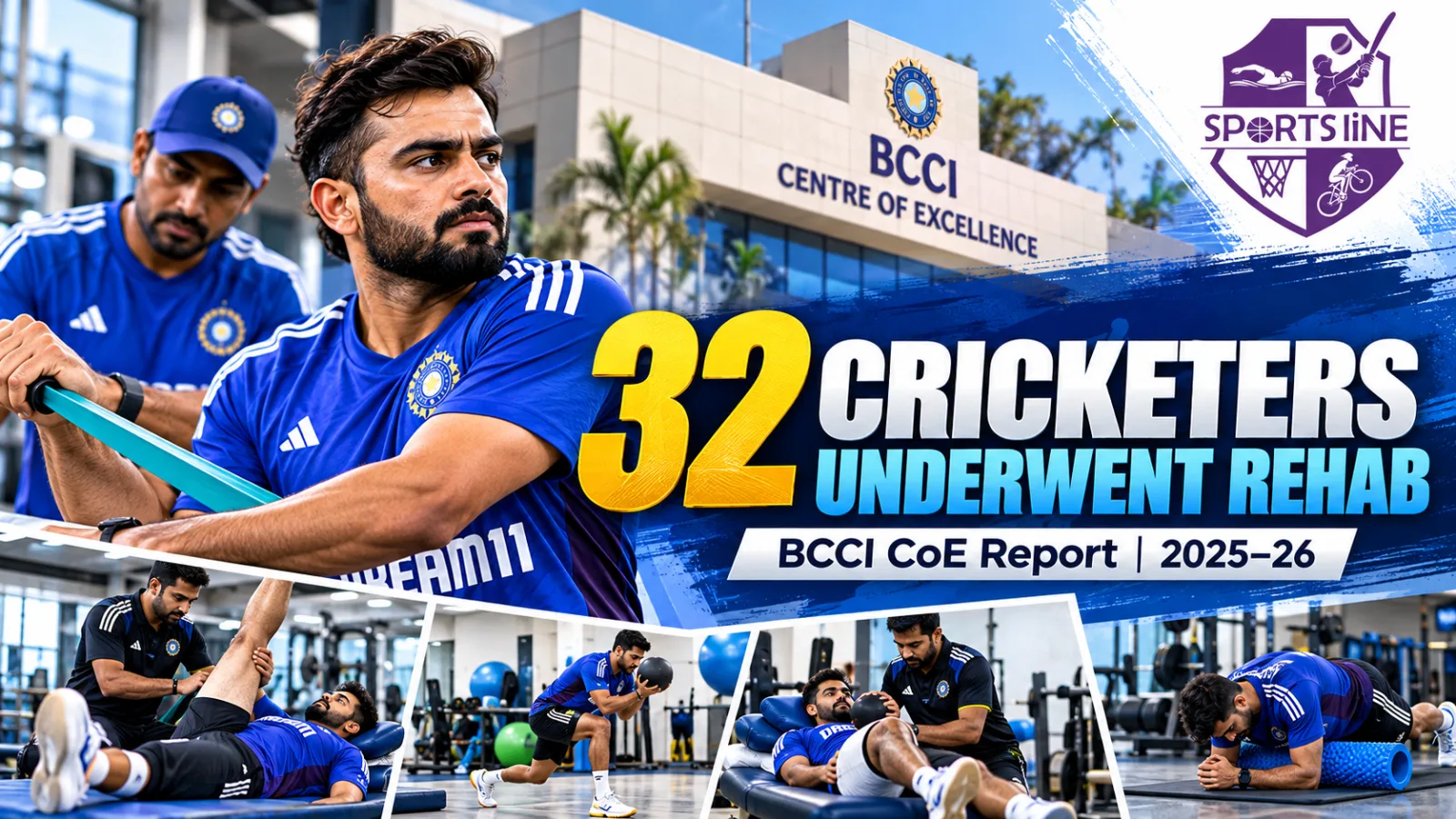
The Board of Control for Cricket in India (BCCI) Centre of Excellence (CoE) handled rehabilitation for 32 top men's team cricketers during the 2025-26 financial year, according to an annual report cited by The Times of India. The report also says the CoE's Sports Science and Medicine team treated or managed injuries involving 68 players across men's and women's cricket.
The figures have brought renewed attention to injury management, player availability and workload planning in Indian cricket.
According to the annual report cited by The Times of India, 32 top men's team players received injury rehabilitation at the CoE between April 2025 and March 2026.
The group included 20 centrally contracted cricketers and 12 players covered under the targeted/India A category. The report does not specify how many separate visits each player made for treatment.
Separately, the CoE's Sports Science and Medicine team managed injuries involving 68 players across genders during the same period. These figures describe different groups and should not be treated as interchangeable.
The report identifies soft-tissue injuries as the most common category among the cases handled by the CoE.
It also mentions Rishabh Pant's treatment following a foot fracture sustained during the Manchester Test in July 2025. The report further states that Rohit Sharma underwent rehabilitation at the facility during the period.
Several other prominent Indian cricketers were included in the report's discussion of injury management and repeat rehabilitation cases. However, rehabilitation history alone does not establish the severity of an injury, the cause of recurrence or the effectiveness of an individual player's recovery programme.
The CoE's projected expenditure for the 2026-27 financial year is ₹127 crore, compared with ₹92 crore in actual expenditure for the preceding year, according to the report.
The expenditure covers more than injury rehabilitation. It also includes administrative costs, courses and match-related expenses.
Consequently, the increase should not be interpreted as a ₹35 crore increase exclusively in medical spending. The available reporting does not provide a complete breakdown of the projected amount by department or activity.
The Times of India report says the CoE's Head of Sports Science and Medicine position had remained vacant following Nitin Patel's departure in March 2025.
In a media advisory dated 11 September 2026, the BCCI invited applications for the position. The advertised role covers sports science and medicine services across the board's elite cricket and CoE programmes, including injury prevention, rehabilitation, physical development and player welfare.
The report also raises concerns about coordination between the CoE and the Indian team's sports medicine staff. These concerns are attributed to the newspaper's reporting and should not be presented as independently established findings without access to the full annual report or further official clarification.
India's international, domestic and franchise cricket schedules create a demanding environment for players, particularly those whose roles require repeated high-intensity bowling, sprinting or all-round workloads.
The BCCI's Centre of Excellence describes its approach as a process involving diagnosis, rehabilitation, strength and conditioning, cricket-specific training and return-to-play benchmarks.
In an official BCCI feature published in August 2026, CoE head VVS Laxman explained that players progress through rehabilitation and workload-building stages before being cleared to return to competition.
This provides useful context for understanding the role of the CoE. However, the reported injury figures alone cannot establish whether scheduling, training, individual biomechanics or other factors caused the injuries.
The key questions are whether improved coordination, appropriate staffing, workload monitoring and rehabilitation processes can help Indian cricket manage player availability more effectively.
The projected budget and the recruitment process provide context for the BCCI's high-performance infrastructure, but their eventual impact will need to be assessed using future evidence, including injury trends, player availability and transparent performance reporting.
For now, the annual-report figures cited by The Times of India offer a snapshot of the rehabilitation workload handled by the CoE during 2025-26. They also underline the importance of distinguishing injury treatment statistics from conclusions about the causes of injuries or the success of prevention programmes.
