Published:
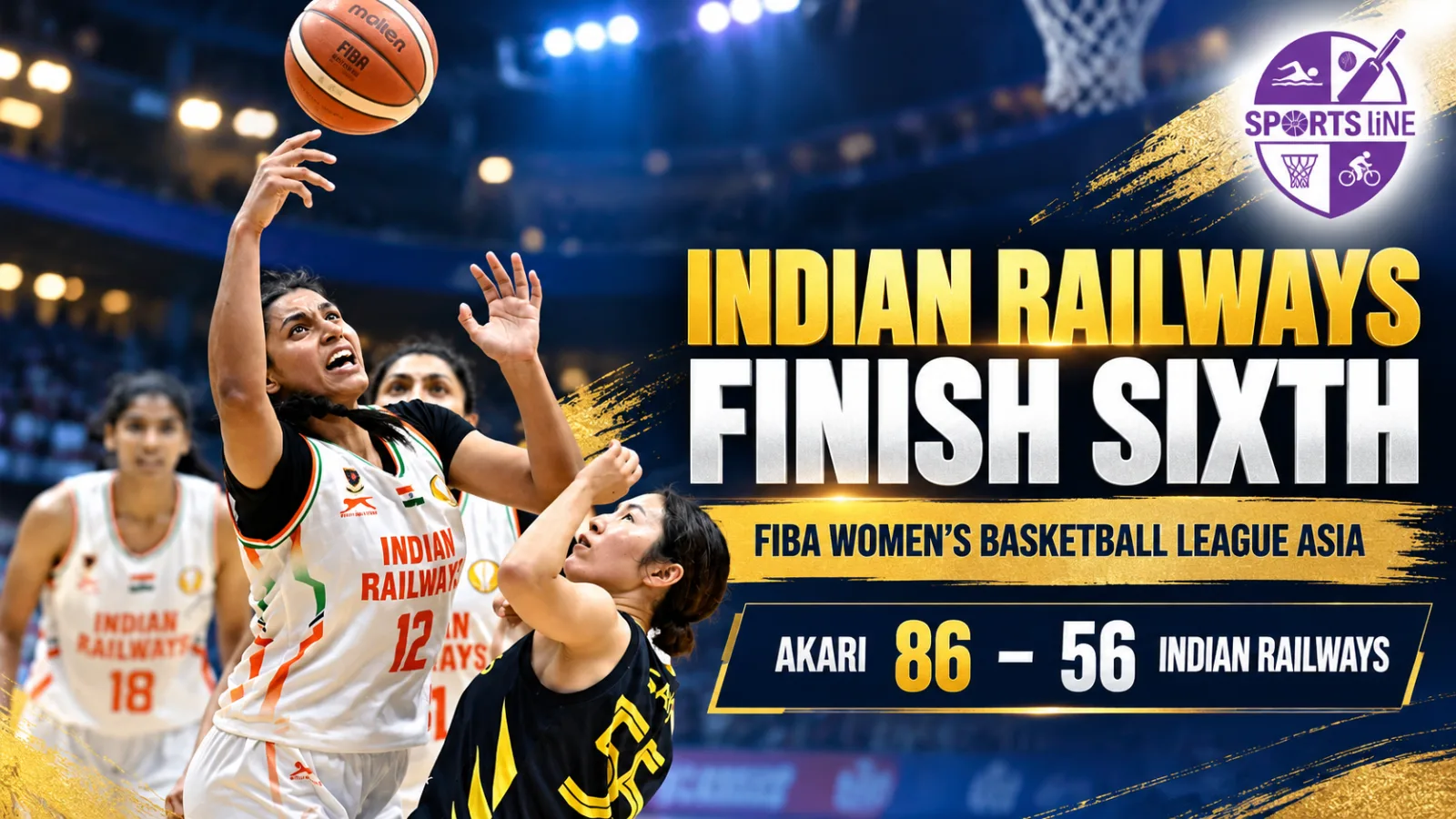
Indian Railways ended their debut campaign in the FIBA Women’s Basketball League Asia with a 56-86 defeat to the Philippines’ Akari Sparks in the fifth-place classification game in Bengaluru on Saturday, October 24, 2026. The result placed the Indian side sixth in the six-team tournament, while Akari secured fifth place in its first appearance at the continental club competition.
The scoreline capped a demanding week for the Indian champions, who were competing against leading clubs from across Asia for the first time. Although Indian Railways could not turn its domestic dominance into a win at the event, the tournament gave the team direct experience of the pace, physicality and depth of top-level Asian women’s club basketball.
Akari took control late in the second quarter before pulling away after half-time. The Sparks built a 42-30 advantage at the interval and extended the margin during the third period, eventually closing out an 86-56 win at Sree Kanteerava Indoor Stadium.
Bre’Amber Scott led Akari with 25 points and six rebounds, while Saicha Grant-Allen contributed 24 points, 11 rebounds and five assists. Their scoring helped Akari finish its tournament on a positive note after losing both group-stage games. The Philippines side had earlier lost 85-75 to Cathay Life Tigers and 94-73 to Sichuan Yuanda Meile.
For Indian Railways, the classification game was an opportunity to close the tournament with a more competitive performance after two heavy defeats in Group B. The experience of facing different styles of play over consecutive days is part of the value of the competition, even when results are difficult.
Indian Railways opened against Japan’s Denso Iris and lost 119-35. Denso established a 27-8 first-quarter lead and went into half-time ahead 58-18. Haruna Kasagi scored 23 points for the Japanese side, while Indian Railways’ Sundhari finished with eight points.
The second group game brought an 81-42 defeat to South Korea’s KB Stars. Manmeet Kaur gave the hosts an early lead with a two-point basket, but it was Indian Railways’ only advantage as the Korean side took control. Kaur led the Indian scoring with 17 points and seven rebounds.
The two losses meant Indian Railways could not advance to the semifinals and instead entered the fifth-place classification game. Their opponents, Akari, had also gone winless in the group phase, making the final fixture a chance for one of the two debuting sides to end its campaign with a victory.
- 86-56: Akari Sparks’ winning score against Indian Railways in the fifth-place game.
- 119-35: Indian Railways’ opening loss to Denso Iris.
- 81-42: Indian Railways’ second group-stage defeat, against KB Stars.
- 17 points: Manmeet Kaur’s team-high score against KB Stars.
- 41 national titles: Indian Railways’ Senior National Championship tally through 2026.
- Six teams: The number of clubs competing in the 2026 edition.
The 2026 tournament marked the first time the FIBA Women’s Basketball League Asia was staged outside China. Bengaluru hosted six clubs representing China, Chinese Taipei, Japan, South Korea, India and the Philippines, with all games held at Sree Kanteerava Indoor Stadium.
Indian Railways arrived as the most successful team in Indian women’s basketball, having won the Senior National Championship 41 times. Their 2026 title was their eighth consecutive national championship, a record of domestic consistency that earned them the opportunity to represent the host nation in the continental competition.
The gap between domestic success and the level of established Asian professional clubs was evident in the results. For Indian Railways, the next step is to assess the lessons from the event: how to create scoring opportunities against organised defences, limit high-percentage shots and maintain intensity across four quarters against deeper rotations.
The FIBA Women’s Basketball League Asia concludes in Bengaluru on October 25 with the championship game and third-place contest. Indian Railways leave the event without a win, but with a benchmark against elite opposition that can inform future preparation and the development of women’s club basketball in India.
The tournament’s broader importance lies in giving Indian players regular exposure to international club standards. Indian Railways’ domestic record remains substantial, and this debut has provided a clearer picture of the areas that need to improve if the country’s leading women’s team is to compete more closely with Asia’s strongest clubs in future editions.
