
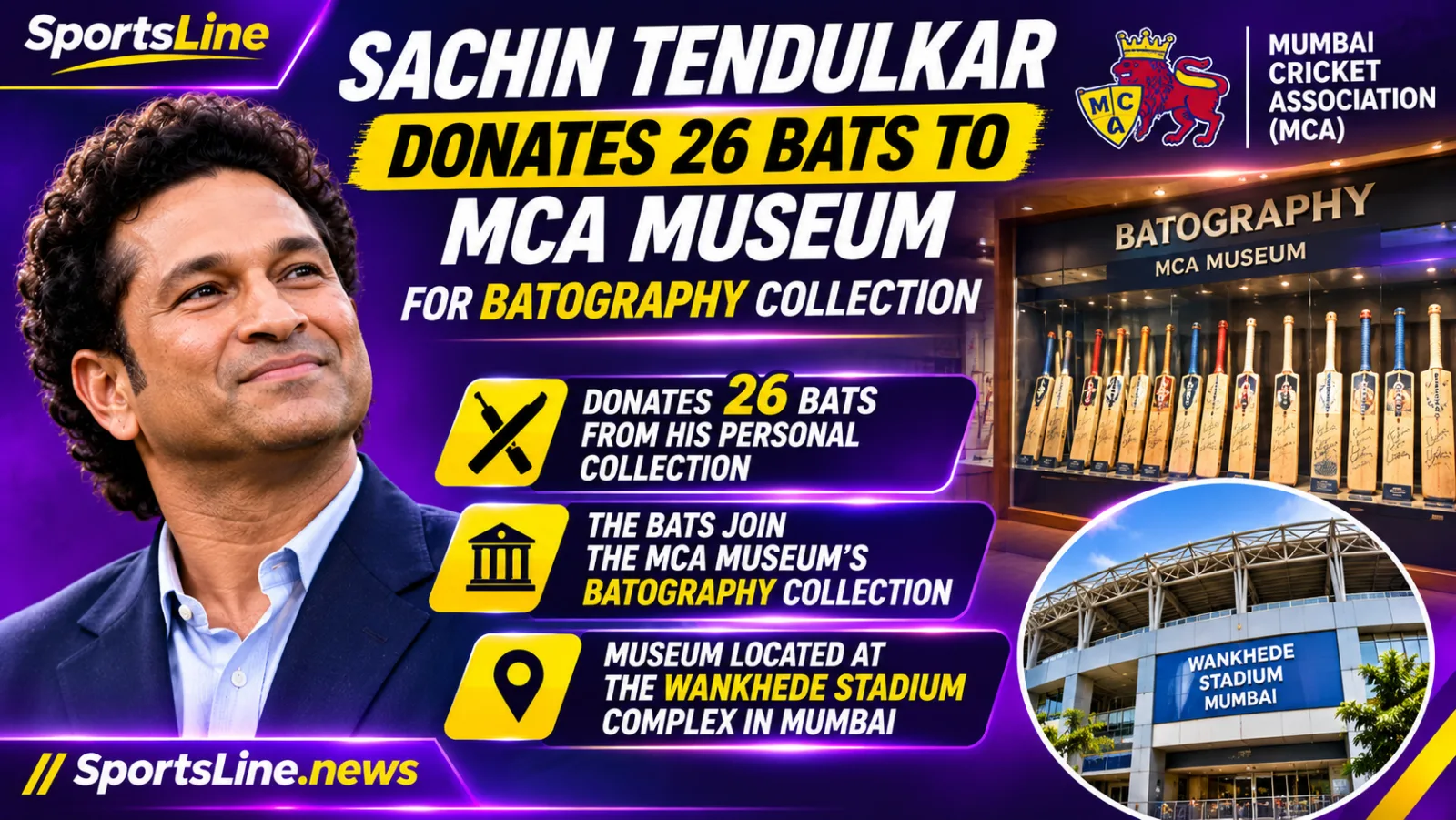
Key points
- Sachin Tendulkar donated 26 bats from his personal collection to the Mumbai Cricket Association museum in Mumbai.
- The bats are part of the MCA museum's Batography collection, which documents the stories behind cricket bats and the players who used them.
- The donation includes bats associated with important phases and milestones in Tendulkar's career.
- The MCA museum is located at the Wankhede Stadium complex and showcases Mumbai cricket history and memorabilia.
- The donation adds to the museum's effort to preserve cricket artefacts and make the game's history accessible to visitors.
- Tendulkar's gift connects his personal playing journey with the wider history of Mumbai cricket.
Sachin Tendulkar has donated 26 bats from his personal collection to the Mumbai Cricket Association (MCA) museum, adding a significant set of memorabilia to its Batography display. The donation brings equipment connected with the legendary batter's career into a museum setting, where visitors can explore the stories behind the bats and the moments they represent.
The collection is housed at the MCA museum at the Wankhede Stadium complex in Mumbai. Tendulkar's contribution links his personal cricketing journey with the wider story of the city, which has produced generations of Indian cricketers and remains one of the country's most important centres of the sport.
Twenty-six bats join the Batography collection
The 26 bats donated by Tendulkar come from his personal collection. Their inclusion in Batography gives the museum a direct connection to one of the most celebrated careers in cricket history. Rather than presenting equipment as ordinary sporting objects, the display uses bats to tell stories about players, performances and the evolution of the game.
For visitors, the significance of a match-used bat often lies in the memories attached to it: the innings played, the conditions faced and the stage of a player's career. Tendulkar's donation makes that connection more immediate by placing objects from his own journey within a public collection devoted to cricket history.
The Sportstar report identifies the donation as 26 bats and places it within the MCA museum's Batography initiative. The contribution also adds to the museum's role as a repository of Mumbai cricket heritage, preserving items that might otherwise remain in private collections.
A personal collection becomes part of Mumbai cricket history
Tendulkar's career is closely associated with Mumbai. He emerged from the city's cricket structure before becoming an international star, and his journey remains one of the most recognisable stories in Indian sport. The donation gives the MCA museum an opportunity to connect the story of an individual player with the institutions, grounds and cricket culture that shaped him.
The MCA museum at Wankhede Stadium is positioned within a venue that has hosted major domestic and international matches. Its exhibits help document the players and events that have shaped Mumbai cricket. Adding Tendulkar's bats strengthens that narrative by bringing in objects from a career that spanned more than two decades at the international level.
Batography's focus on the stories behind bats also offers a different way to approach sporting memorabilia. A bat can represent a technical change, a player's preferred style or a particular period in a career. When displayed with context, such objects can help younger visitors understand how cricket has evolved and why certain performances remain part of the sport's collective memory.
The scale of Tendulkar's cricketing legacy
Tendulkar's donation carries added resonance because of the records he established during his career. He played 200 Test matches, the most by any cricketer, and scored 15,921 runs in the format. He also remains the only batter to have scored 100 international centuries, finishing with 51 in Tests and 49 in One-Day Internationals.
He made his international debut in 1989 and retired from international cricket in 2013. Across that period, he became a defining figure for Indian cricket and a role model for players who followed. His long career included major milestones in Tests and ODIs, as well as a central role in India's 2011 World Cup-winning campaign.
The bats now entering the MCA museum offer a physical complement to those numbers. Statistics explain the scale of Tendulkar's achievements, while the equipment associated with his career can help visitors imagine the craft and preparation behind the performances.
Museums help keep cricket's stories accessible
Sports museums preserve more than trophies and scorecards. They provide a place for equipment, photographs and personal objects to be seen alongside the stories that give them meaning. Tendulkar's donation is valuable in that context because it brings a substantial group of items from a major Indian cricketer into a collection accessible to the public.
For Mumbai cricket, the MCA museum can serve as a bridge between generations. Long-time followers can revisit familiar names and moments, while younger visitors can learn about the players who helped establish the city's reputation. The Batography display adds another layer by focusing on the tools of the game and the memories associated with them.
A gift that connects past and future generations
Tendulkar's 26-bat donation is a gesture that extends his cricketing legacy beyond records and match results. By placing objects from his career in the MCA museum, he helps preserve a part of the sport's history for future visitors. The collection can encourage young cricketers to look beyond statistics and understand the dedication, technique and preparation behind a long career.
The donation also reinforces Mumbai's place in Indian cricket. The city has long been associated with strong domestic competition and a steady stream of international players. With Tendulkar's bats now part of the museum's Batography collection, another chapter of that history can be explored through the equipment used by one of its most influential figures.
Frequently asked questions
How many bats did Sachin Tendulkar donate to the MCA museum?
Sachin Tendulkar donated 26 bats from his personal collection to the Mumbai Cricket Association museum. The bats have been added to the museum's Batography collection, which presents the stories and memories connected with cricket bats and the players who used them.
What is the Batography collection at the MCA museum?
Batography is a museum display built around cricket bats and their stories. Tendulkar's donation of 26 bats adds artefacts from his career to the collection and helps visitors connect particular pieces of equipment with moments in the history of Mumbai and Indian cricket.
Where is the Mumbai Cricket Association museum located?
The Mumbai Cricket Association museum is located at the Wankhede Stadium complex in Mumbai. It showcases the city's cricketing history through memorabilia and exhibits, including the Batography collection, which records stories associated with bats and their players.
Why is Sachin Tendulkar's donation significant?
The donation brings 26 bats from one of India's most celebrated cricketers into a public cricket museum. The collection offers visitors a tangible link to Tendulkar's playing career and adds personal memorabilia to the wider record of Mumbai cricket history.
How many international centuries did Sachin Tendulkar score?
Sachin Tendulkar scored 100 international centuries during his career: 51 in Test cricket and 49 in One-Day Internationals. He remains the only batter to reach that milestone, alongside records including 200 Test appearances and 15,921 Test runs.