
Key points
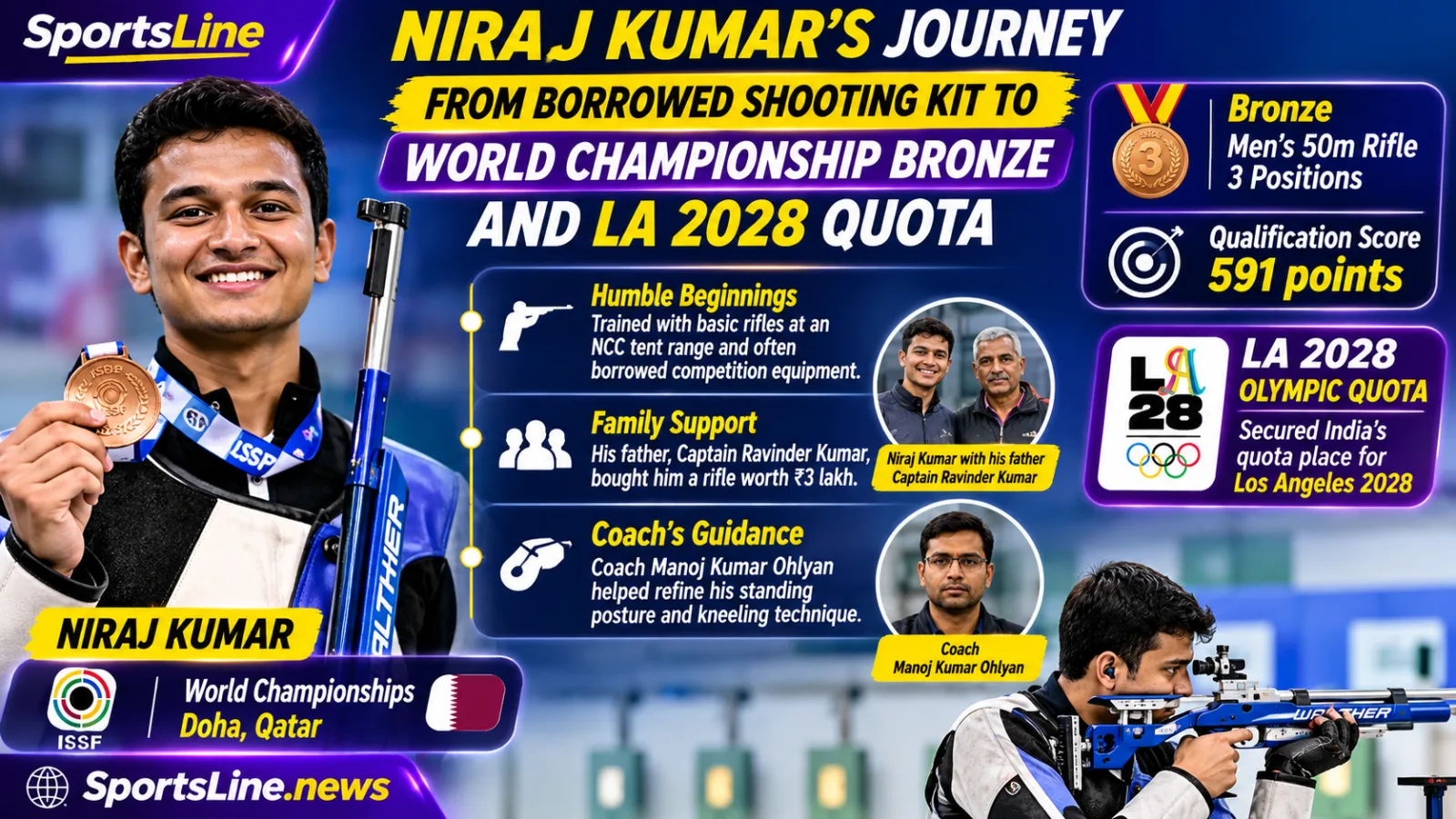
- Niraj Kumar won bronze in the men's 50m rifle 3 positions event at the ISSF World Championships in Doha and secured an Olympic quota place for India at Los Angeles 2028.
- His father, Captain Ravinder Kumar, bought him a rifle worth ₹3 lakh after Niraj chose shooting over pursuing graduation.
- As a young shooter, Niraj trained with basic rifles at a makeshift NCC tent range in Talwara and borrowed competition kit from the son of Lt Col TS Dalal.
- Niraj won silver at the 2016 nationals using the borrowed kit and gold the following year, helping him earn recruitment into the Indian Navy.
- He topped the Doha qualification with 591 points: 196 in kneeling, 198 in prone and 197 in standing.
- National coach Manoj Kumar Ohlyan worked with Niraj on his standing posture and kneeling sling adjustment to improve his 50m rifle 3 positions technique.
Niraj Kumar's bronze medal in the men's 50m rifle 3 positions event at the ISSF World Championships in Doha is the latest milestone in a journey that began with basic rifles in a makeshift National Cadet Corps (NCC) tent range. The Indian shooter also secured a quota place for the country at the Los Angeles 2028 Olympics, turning years of family support, borrowed equipment and technical work into a world championship breakthrough.
For his family in Behmawa, a village near the Punjab-Himachal border, the achievement carries a personal meaning. Niraj's father, Captain Ravinder Kumar, remembered how his son had asked for a rifle around a decade ago, when his father wanted him to pursue graduation. Ravinder eventually spent ₹3 lakh on the rifle, backing the young shooter's decision to follow the sport.
From an NCC tent range to the national podium
Niraj's early training took place at a makeshift NCC range in Talwara, where the facilities were modest and the rifles basic. Even after receiving his own rifle, he did not have the specialised kit required for competitions. He contacted Lt Col TS Dalal, who was heading the NCC directorate in Chandigarh, and was offered the use of a kit belonging to Dalal's son in Rohtak.
Niraj travelled by bus to collect the equipment and used it at the 2016 national championships, where he won silver. The following year, he won gold. Those performances opened a route into the Indian Navy: Navy coach PT Raghunath had told him that a strong showing could help him earn recruitment, and Niraj subsequently appeared for the trials and joined the service.
The early years were marked by resourcefulness as much as talent. Niraj recalled that the tent range and borrowed kit were part of his formative experience. His father also remembered helping him practise at home, asking him to dry-fire with a stick and aim at a cardboard box. Those improvised sessions became part of the foundation for a career that would eventually take him to the world championship podium.
Learning from the world's best
After joining the Navy, Niraj had greater access to equipment, but he still had to build his technique through study and repetition. He watched videos of established 50m rifle 3 positions shooters, including American Matthew Emmons and India's Sanjiv Rajput. He focused not only on their overall technique but also on the small adjustments they made in kneeling, prone and standing positions.
His progress continued through the junior ranks. Niraj won silver at the Asian Junior Championships in Doha and broke into the senior Indian team in 2021. That year, he reached his first final at a senior international competition, the World Cup in Delhi, where he finished eighth. In the following seasons, he continued to gain experience at major events, reaching two more World Cup finals, finishing fifth at the previous year's World Championships and placing eighth at the Asian Games.
Technical changes helped unlock the Doha performance
National coach Manoj Kumar Ohlyan identified specific areas that needed improvement as Niraj developed into a senior international contender. His prone position was already a strength, but his standing posture needed attention because his back tended to bend. The coaching work also focused on the kneeling position, where adjustments to the sling were made to reduce the transfer of the shooter's pulse through the equipment.
The work was tested in Doha. Niraj topped qualification with 591 points, recording 196 in kneeling, 198 in prone and 197 in standing. His previous best in qualification was 592 at the World Championships the year before. Conditions were difficult, with wind affecting scores, but he produced strong series in prone and the final standing sequence to finish first in the qualifying round.
Climbing through the final to secure bronze
Niraj's route through the final required him to keep improving across all three positions. He was fifth after the kneeling series, while fellow Indian Aishwary Pratap Singh Tomar occupied second place. Niraj moved up to third after the prone sequence and then climbed to second after standing, behind Dmitrii Pimenov and ahead of world No. 1 Jon-Hermann Hegg of Norway.
During the single-shot elimination phase, Pimenov opened a five-point advantage. Niraj remained in the medal positions and had a chance to secure the Olympic quota before Hegg's elimination, with Tomar finishing fifth. In the final exchanges, Niraj held a 0.7-point lead over Slovakia's Patrik Jany, but a 9.4 from the Indian and a 10.4 from Jany changed the margin. Niraj ultimately secured the bronze medal and the quota place for India.
The Olympic qualification added pressure to the closing shots, but Niraj said he believed he could secure the quota. He also spoke of the satisfaction of winning a medal alongside shooters he admired, including Tomar and Hegg. His next ambition is to seal the Olympic place and return to his village one day with an Olympic medal.
A medal built on family support and persistence
The Doha bronze is a sporting achievement, but the route to it also reflects the support that helped Niraj continue when facilities and equipment were limited. His father's decision to spend ₹3 lakh on a rifle, the borrowed kit that allowed him to compete at the 2016 nationals and the technical work with coaches all formed part of the progression from an NCC tent range to the international podium.
For Indian shooting, the result brings another Olympic quota opportunity in the men's 50m rifle 3 positions event. For Niraj, it is a step towards the Los Angeles 2028 Games and a chance to build on the experience of a world championship medal. The story of his rise is also a reminder that elite performance can emerge from modest beginnings when opportunity, support and sustained work come together.
Frequently asked questions
Which medal did Niraj Kumar win at the ISSF World Championships in Doha?
Niraj Kumar won bronze in the men's 50m rifle 3 positions event at the ISSF World Championships in Doha. His performance also secured an Olympic quota place for India at the Los Angeles 2028 Games, making the result significant beyond the world championship podium.
How did Niraj Kumar begin his shooting career?
Niraj began shooting at a makeshift NCC tent range in Talwara, using basic rifles and limited facilities. When he needed competition equipment, he borrowed a kit from the son of Lt Col TS Dalal, then head of the NCC directorate in Chandigarh, and travelled to collect it.
Who helped Niraj Kumar buy his first rifle?
His father, Captain Ravinder Kumar, bought him a rifle worth ₹3 lakh after Niraj asked to pursue shooting instead of continuing with graduation. Ravinder later recalled supporting his son's ambition despite having limited savings after retiring and building the family home.
What was Niraj Kumar's qualification score in Doha?
Niraj topped the men's 50m rifle 3 positions qualification in Doha with 591 points. His series comprised 196 in kneeling, 198 in prone and 197 in standing. The score was one point below his previous personal best qualification score of 592.
How did Niraj Kumar prepare technically for the 50m rifle 3 positions event?
Niraj studied videos of leading shooters Matthew Emmons and Sanjiv Rajput to understand technique and adjustments in all three positions. National coach Manoj Kumar Ohlyan later worked with him on his standing posture and kneeling sling adjustment to reduce pulse transfer.