
Key points
- Luke Browning won the 2026 Super Formula Rookie of the Year award.
- He scored 24 championship points for REALIZE KONDO RACING.
- Browning identified the single fresh-tyre qualifying opportunity as his biggest challenge.
- He finished seventh in the final race at Suzuka after starting 12th.
- His 2026 campaign included fourth-place finishes at Motegi and Suzuka.
- He recorded a best qualifying result of third at Fuji in wet conditions.
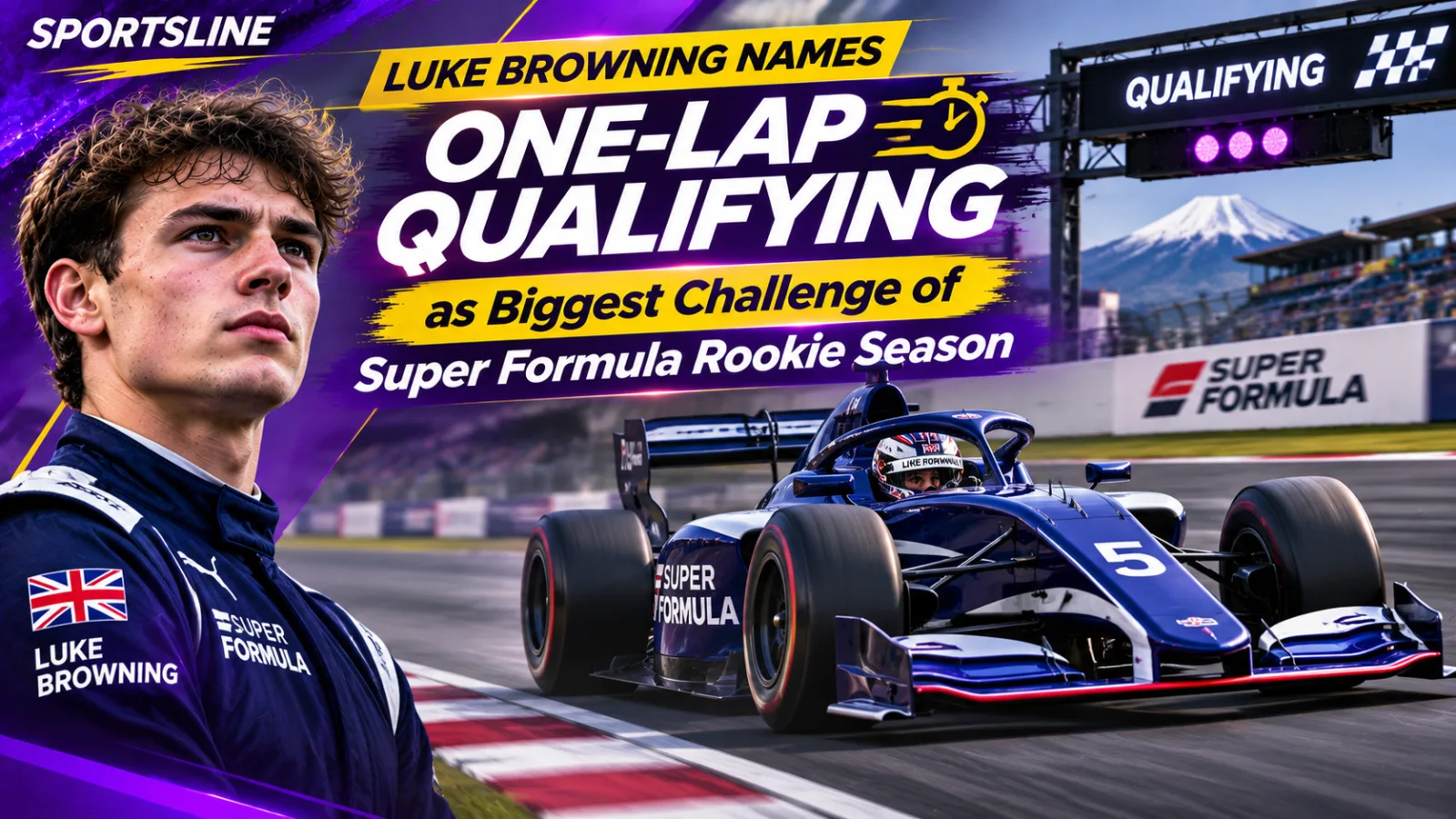
- Luke Browning’s first season in Japan’s Super Formula championship was a demanding education in a category where a single qualifying lap can shape an entire weekend. The Williams Formula 1 reserve driver identified the challenge of extracting performance from a fresh set of tyres in a single qualifying opportunity as the hardest part of his maiden campaign, particularly while learning circuits where he had little or no previous running.
The Briton ended the 2026 season with the Rookie of the Year award after collecting 24 championship points for REALIZE KONDO RACING. His campaign included two fourth-place finishes and a third-place qualifying result at Fuji, but the year was far from straightforward. Browning had to adapt to a new car, unfamiliar venues and a team environment that was also building its understanding of the series.
One new-tyre qualifying lap proved a major challenge
In comments reported after the season finale, Browning explained that the qualifying format and the limited opportunity to use new tyres made it difficult to find the ultimate lap time. During practice, he often ran on used tyres. When qualifying arrived, he had one key opportunity on fresh rubber to deliver a representative lap and secure a strong grid position.
That placed a premium on preparation, confidence and precision. A driver learning a circuit must build references for braking points, corner entry, balance and tyre behaviour. In Super Formula, where the field is closely matched, even a small loss can have a significant effect on the starting position. Browning said the process at venues such as Sportsland SUGO and Autopolis could feel like trial and error because he had not tested at those tracks beforehand.
The challenge was not simply about driving quickly. Browning and the team needed to understand how to prepare the car for a short qualifying run, how the tyres would respond and how to put all the information together when the opportunity came. The season gave him valuable experience, but it also exposed an area where he believes he can improve.
Rookie of the Year after a season of learning
Browning’s final result was enough to secure the 2026 Rookie of the Year award. He finished seventh in the final race at Suzuka, adding four points to his campaign and ending the season with 24 championship points. The finale also brought progress in dry qualifying, as he reached Q2 for the first time during the year before starting the race 12th after his fastest lap was deleted for a track-limits infringement.
He made a strong start in the race, gaining five positions on the opening lap to move into seventh. Browning then extended his first stint and completed his mandatory pit stop on lap 29 of the 31-lap contest. He rejoined behind Kamui Kobayashi and held seventh to the finish. The result secured the rookie award and provided a positive conclusion to a season in which qualifying had often been his biggest obstacle.
His campaign also featured two fourth-place finishes, at Motegi and Suzuka, and a best qualifying result of third at Fuji in wet conditions. At Motegi, he climbed from 21st on the grid to fourth through a late pit stop and strong tyre management. The Fuji performance showed that he could compete near the front when conditions suited his strengths.
Learning curve extended beyond the driver
The adjustment was not limited to Browning. The Williams junior arrived in Japan after competing in Formula 3 and Formula 2, but the Super Formula circuits and operating environment presented a different set of demands. His engineer Ed Regan was also new to racing in Japan, meaning the driver and engineering group had to build track knowledge and car understanding together.
REALIZE KONDO RACING had its own performance targets after a difficult period in the championship. That meant Browning’s first season involved more than adapting to a new single-seater. The team needed to identify a reliable set-up window, understand how its package behaved at different venues and convert practice pace into qualifying performance.
There were encouraging signs. The recovery drive at Motegi demonstrated strategic awareness and tyre management, while the wet-weather qualifying performance at Fuji highlighted Browning’s ability in changing conditions. The late-season progress at Suzuka, including his first Q2 appearance in dry conditions, suggested that the experience was beginning to translate into more consistent execution.
What the season means for Browning’s future
The Rookie of the Year award is a meaningful achievement, but Browning has made clear that his wider ambition remains reaching Formula 1. His Super Formula campaign was an opportunity to broaden his experience in a highly competitive single-seater series while continuing his development as a Williams driver. The lessons from Japan, especially around qualifying preparation and adapting quickly to new circuits, can be applied wherever his career takes him next.
Whether he returns to Super Formula for another season will depend on decisions around his programme. A second campaign would give him the benefit of returning to tracks he now knows, rather than starting from scratch at every venue. It would also offer a chance to address the qualifying weakness he identified and build on the race pace that produced several strong results.
For Browning, the headline from 2026 is therefore more nuanced than a rookie award. He leaves Japan with 24 points, a handful of standout performances and a clear understanding of the area that cost him most. Turning that learning into consistent one-lap speed could be the key step in his next stage of development.
Frequently asked questions
What did Luke Browning find hardest about his first Super Formula season?
Browning identified qualifying as his biggest challenge, particularly having to produce a decisive lap on fresh tyres after often using used tyres during practice. Learning unfamiliar circuits at the same time made it difficult to find the final increments of performance when the qualifying opportunity arrived.
Did Luke Browning win the Super Formula Rookie of the Year award in 2026?
Yes. Browning secured the 2026 Super Formula Rookie of the Year award after finishing the season with 24 championship points for REALIZE KONDO RACING. His seventh-place finish in the final race at Suzuka helped complete his rookie campaign on a positive note.
How many points did Luke Browning score in Super Formula in 2026?
Browning collected 24 championship points during the 2026 Super Formula season. His campaign included two fourth-place finishes, at Motegi and Suzuka, and a best qualifying result of third at Fuji in wet conditions.
What was Luke Browning’s result in the final 2026 Super Formula race?
Browning finished seventh in the final race at Suzuka. He started 12th after his fastest qualifying lap was deleted for a track-limits infringement, gained five places on the opening lap and completed his mandatory pit stop on lap 29 of the 31-lap race.
Which team did Luke Browning drive for in Super Formula?
Browning competed for REALIZE KONDO RACING in the 2026 Super Formula season. The Williams Formula 1 junior and reserve driver worked with the Japanese team as he adapted to the championship, its circuits and its qualifying demands.