
Key points
- José Raúl Capablanca resigned the adjourned 34th game of the 1927 World Championship by writing a letter to Alexander Alekhine.
- Emanuel Lasker ended his 1921 title match against Capablanca after 14 games, citing ill health and difficult conditions in Havana.
- Bobby Fischer forfeited his 1975 title defence after FIDE rejected key conditions he demanded for the match.
- The 1984 Kasparov-Karpov match was stopped by FIDE president Florencio Campomanes after 48 games, with Karpov leading 5-3.
- Garry Kasparov won the 1985 rematch and became world champion at 22.
- Magnus Carlsen announced in 2022 that he would not defend his classical world title again.
- The World Chess Championship has produced some of sport's most dramatic contests, but not every title change has come through a final move on the board. Resignation by letter, a champion refusing to defend the crown and a marathon match abandoned before a winner emerged have all shaped the competition's history.
With reigning champion Gukesh Dommaraju and challenger Javokhir Sindarov preparing for a landmark match, those episodes offer a reminder that the road to the chess crown can be as unusual as it is demanding. Both players are 20, and their meeting is set to become the youngest World Championship match in history.
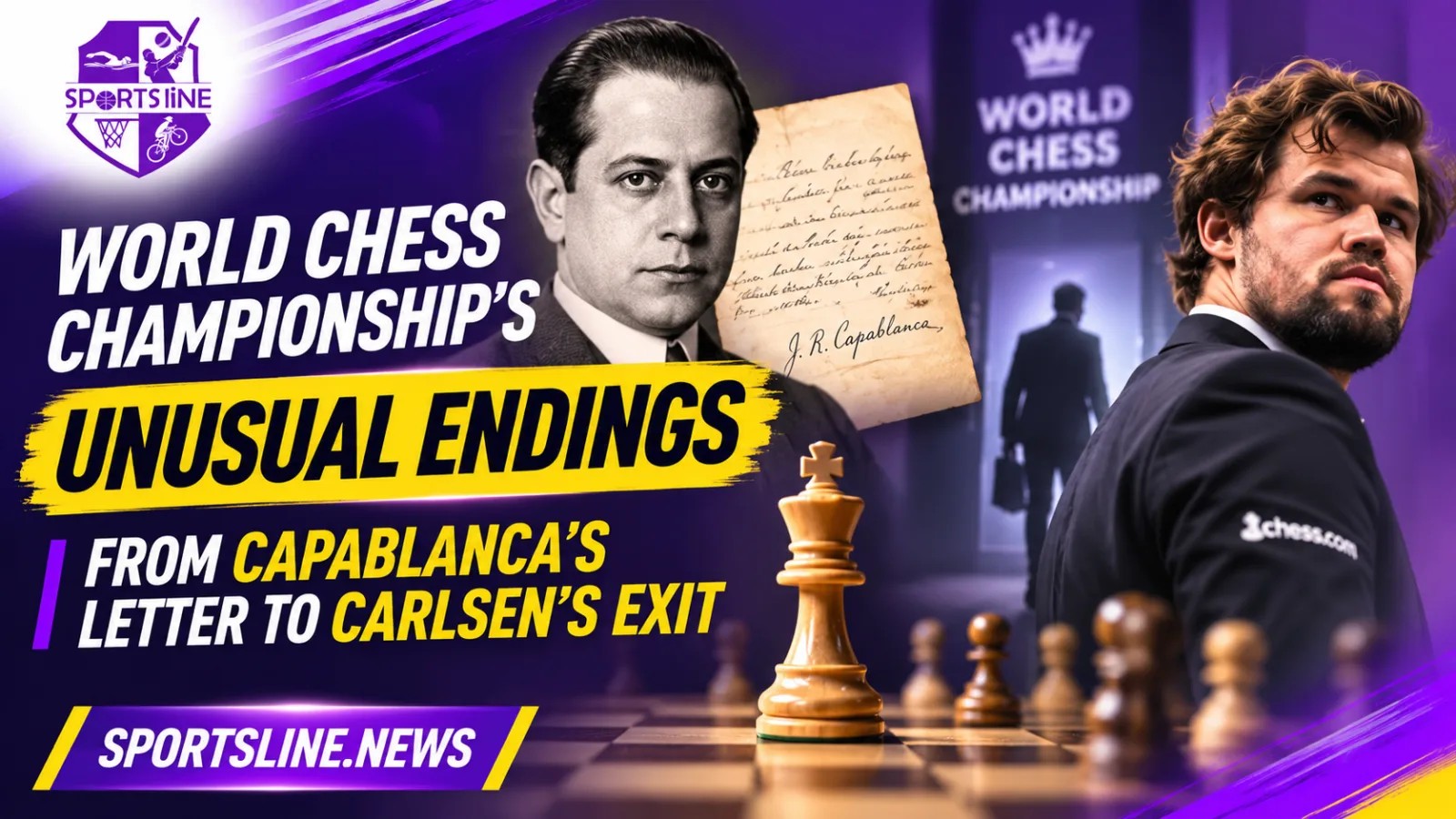
Capablanca’s letter brings the 1927 match to an abrupt end
For 73 days, José Raúl Capablanca fought to retain his world title against Alexander Alekhine. The match in Buenos Aires stretched across more than two months, with the 34th game adjourned. On November 29, 1927, Capablanca chose not to return to the board. Instead, he wrote to Alekhine, resigned the game and congratulated his opponent on becoming world champion.
The decision brought an anticlimactic end to a long and exhausting contest. According to the final score, Alekhine won 18½-15½, with six wins to Capablanca's three and 25 drawn games. The title changed hands through a written message rather than a final over-the-board move. The episode remains one of the most unusual endings in the championship's history.
Lasker’s 1921 resignation ends a 27-year reign
Capablanca had himself become champion through an unusual conclusion six years earlier. In 1921, Emanuel Lasker, who had held the title since 1894, wrote to the match referee proposing to resign his match against the Cuban. After 14 games, Capablanca led 9-5, with four wins and ten draws. Lasker had not won a game.
Lasker cited ill health and the difficult playing conditions in Havana. His decision ended a 27-year reign, the longest in World Championship history. The match did not run its full course, and the title passed to Capablanca without the contest reaching its originally intended finish.
Fischer’s refusal gives Karpov the title in 1975
In 1975, Bobby Fischer relinquished the world title without playing challenger Anatoly Karpov. Fischer, who had dethroned Boris Spassky in 1972, sought changes to the match format. Among his demands was a first-to-ten-wins system, along with a provision that the titleholder would retain the crown if the score reached 9-9.
FIDE did not accept all of Fischer's conditions. The American declined to defend his title, and Karpov was declared world champion by default. It was another extraordinary transfer of the crown: the challenger became champion without a championship match being played.
The 1984 Kasparov-Karpov marathon is stopped
The 1984 contest between Anatoly Karpov and Garry Kasparov seemed to have no end. Played in Moscow under rules that required a player to win six games, the match ran for more than five months and reached 48 games. Forty of those games were drawn.
Karpov made the early running, taking a 4-0 lead after nine games. After 17 consecutive draws, he moved to 5-0 and stood one win away from retaining the title. Kasparov refused to give up, however, and won three games to reduce the deficit to 5-3. With Kasparov having won the previous two games, FIDE president Florencio Campomanes controversially called off the match.
A rematch took place in Moscow in 1985, this time over a maximum of 24 games. Kasparov won and became world champion at 22. Karpov later reflected that a 6-0 defeat in the original match could have had a lasting psychological effect on Kasparov's career.
Carlsen chooses not to defend his crown
Magnus Carlsen's departure from the classical championship cycle was different from the earlier cases. After nearly a decade as world champion and four successful title defences, the Norwegian announced in 2022 that he would not defend the title again. He had not been forced out by a match result or a dispute over a particular game; he had decided that he no longer wanted to continue in the championship cycle.
Carlsen later described his relationship with the World Championship as having become toxic, while saying he remained happy playing chess before and after holding the classical title. His decision closed a significant chapter in modern chess and showed that even a dominant champion could choose to walk away.
A new chapter awaits Gukesh and Sindarov
The upcoming meeting between Gukesh and Sindarov will add another chapter to this long history. Gukesh, India's reigning champion, is preparing to defend the title against Uzbekistan's Sindarov in Geneva. The match will be played over 14 classical games, with the first player to reach 7½ points becoming champion. If the score is tied at 7-7, faster time-control tie-breaks will decide the title.
The championship's past is filled with contests decided by endurance, strategy, controversy and personal choice. From Capablanca's letter to Fischer's refusal and Carlsen's exit, the title has changed hands in ways that are hard to predict. Gukesh and Sindarov will now have the opportunity to write their own chapter—one that, unlike some of the most unusual episodes in history, will be decided across the chessboard.
Frequently asked questions
How did Alexander Alekhine become world champion in 1927?
Alekhine became world champion after José Raúl Capablanca resigned the adjourned 34th game by letter on November 29, 1927. Capablanca congratulated Alekhine in the note, bringing an exhausting match in Buenos Aires to an abrupt end without the players returning to the board.
Why did Emanuel Lasker resign against Capablanca in 1921?
Lasker proposed resigning after 14 games, with Capablanca leading 9-5 and Lasker yet to win a game. He cited ill health and the difficult playing conditions in Havana, saying the climate had affected his ability to compete.
Why was Bobby Fischer not involved in the 1975 World Championship match?
Fischer made demands about the match format, including a first-to-ten-wins system and a provision for the champion to retain the title if the score reached 9-9. FIDE did not accept all his conditions, and Fischer declined to defend his title, allowing Anatoly Karpov to become champion by default.
Why was the 1984 Kasparov-Karpov match stopped?
The match was halted by FIDE president Florencio Campomanes after 48 games and more than five months. Karpov led 5-3 under the first-to-six-wins rules, but Kasparov had won the previous two games and was mounting a comeback. A 24-game rematch was organised for 1985.
When did Magnus Carlsen give up the classical world title?
Carlsen announced in 2022 that he would not defend his classical world championship title again. After nearly a decade as champion and four successful title defences, he said his relationship with the championship had become difficult and that he was comfortable stepping away from the cycle.