
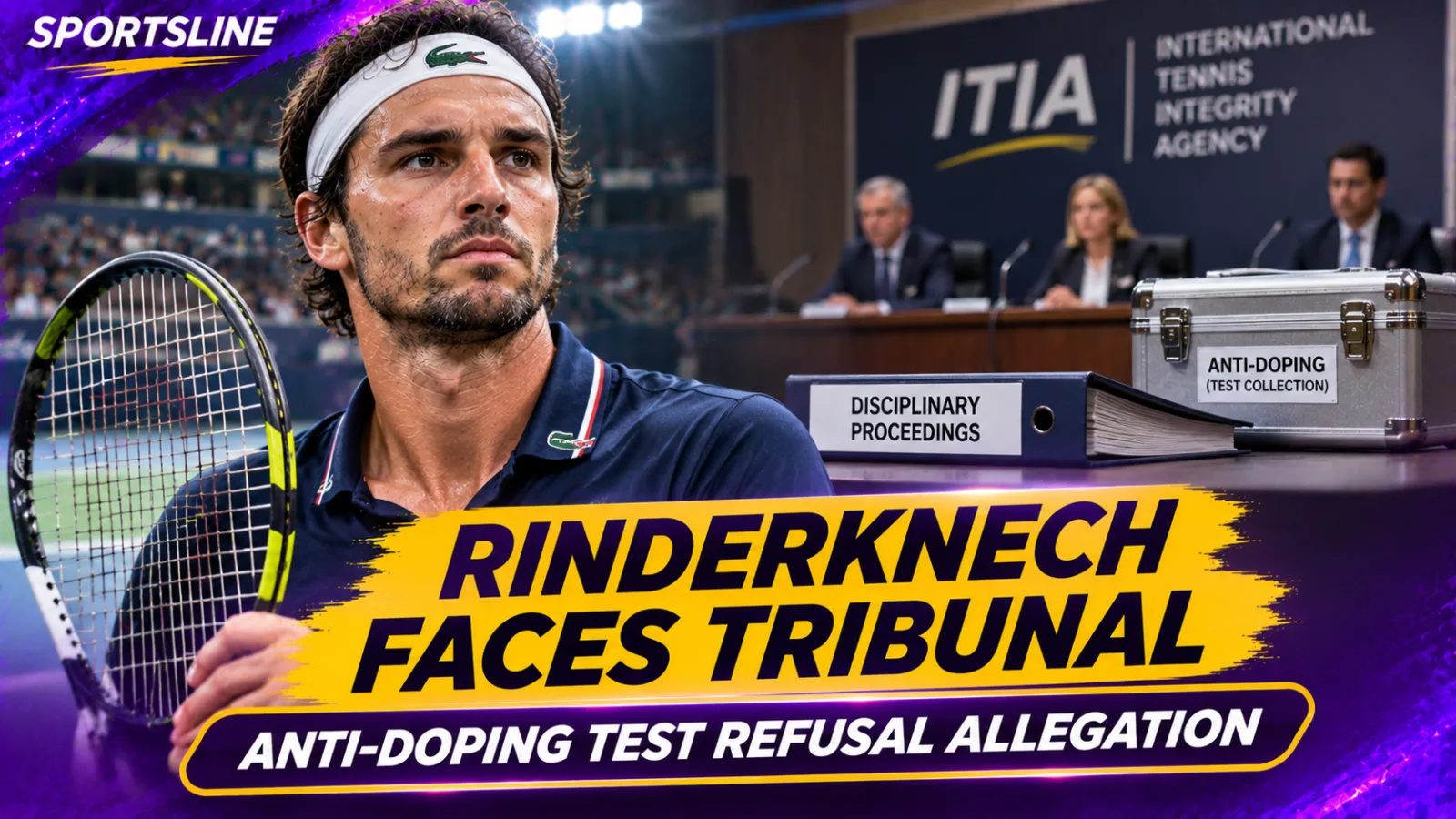
Key points
- The ITIA confirmed on November 25, 2026, that Arthur Rinderknech has been charged with refusing an anti-doping test.
- The alleged incident reportedly occurred in Brittany in June 2026, according to French media reports.
- Rinderknech, 31, denies the allegation and has requested a hearing before an independent tribunal.
- The ITIA said the case is expected to be heard by an independent tribunal early in 2027 and declined to discuss details.
- A four-year ban is the reported maximum potential sanction for a test refusal; no sanction has been imposed in Rinderknech’s case.
- Rinderknech is ranked No. 57 and reached the 2025 Shanghai Masters final.
- Former Wimbledon champion Marketa Vondrousova received a four-year ban in a separate test-refusal case and has appealed to the Court of Arbitration for Sport.
- French tennis player Arthur Rinderknech has been charged by the International Tennis Integrity Agency (ITIA) over an alleged refusal to undergo an anti-doping test. The 31-year-old has denied the allegation and says he has requested that the case be heard by an independent tribunal, where he believes he will be cleared.
The development was confirmed by the ITIA on Wednesday, November 25, 2026, after reports in the French media brought the matter into the public domain. The agency said it was disappointed that confidential details had emerged and declined to discuss the specifics of the investigation. It confirmed that the case is expected to be heard by an independent tribunal early next year.
French newspaper L’Équipe reported that the alleged incident took place in Brittany in June. The report said Rinderknech could face a suspension of up to four years if found to have committed an anti-doping rule violation. That is a potential maximum sanction, not a finding against the player. No tribunal has yet determined the facts or ruled on the charge.
Rinderknech denies the allegation and requests a hearing
Rinderknech responded to the reports in a statement posted on Instagram. He said he had already informed the ITIA that he denies the allegation and had asked for the matter to be determined by an independent tribunal, as is his right. He also criticised the public disclosure of a case that he understood was meant to remain confidential.
The Frenchman said he would present the full details of the situation to the tribunal and would not comment further on the allegations publicly at this stage. He expressed confidence that the panel would exonerate him. Rinderknech also stated that he had never taken a banned substance and said his achievements in professional tennis had been built through hard work and integrity.
It is important to distinguish the charge from a proven doping offence. The allegation reported in this case concerns an alleged refusal to provide a sample, rather than an announced positive test for a prohibited substance. The independent process will assess the evidence and determine whether an anti-doping rule violation occurred.
What the ITIA has confirmed about the case
The ITIA is responsible for administering anti-doping and anti-corruption programmes in elite tennis. In its response to the reports, the agency confirmed that Rinderknech had been charged with refusing a test. It said it would not comment further on the specifics while the process is ongoing.
The agency said the case would be heard by an independent tribunal early in 2027. Under the tennis anti-doping framework, an independent hearing panel considers the evidence presented by the parties and issues a decision. The ITIA’s published case process explains that a hearing panel is made up of independent legal, medical or scientific experts, and that decisions can be appealed to the Court of Arbitration for Sport.
Sky Sports reported that the maximum period of ineligibility for a refusal charge could be four years, while the sanction may be reduced in circumstances where the panel finds no significant fault. The eventual outcome, if any violation is established, will depend on the evidence and the tribunal’s assessment. At this stage, no suspension has been announced against Rinderknech in connection with the allegation.
Why the case has drawn attention in tennis
The case has attracted attention because refusal or evasion of a doping test is treated seriously under anti-doping rules. A test refusal is distinct from a missed test and is assessed under the applicable rules and circumstances. The hearing will be the forum for both sides to put forward their accounts and supporting evidence.
One recent point of comparison is the case of Czech player Marketa Vondrousova. An independent tribunal imposed a four-year ban on the former Wimbledon champion in June 2026 after finding that she had refused an out-of-competition test in December 2025. Vondrousova has appealed that decision to the Court of Arbitration for Sport. Her case is separate from Rinderknech’s and does not determine its outcome.
Rinderknech, currently ranked No. 57 in the world according to reports, reached a career-high ranking of No. 24. He made the final of the 2025 Shanghai Masters, where he lost to his cousin Valentin Vacherot, and has continued to compete on the ATP Tour. His best Grand Slam result was a fourth-round appearance at the US Open in 2025.
The next major step is the independent tribunal hearing expected early next year. Until the panel issues its decision, the allegation remains contested and Rinderknech is entitled to have his case assessed through the established process. The player has said he will provide his account to the tribunal and is confident of being exonerated.
Frequently asked questions
What has Arthur Rinderknech been charged with?
The International Tennis Integrity Agency confirmed that Rinderknech has been charged with refusing an anti-doping test. Reports say the alleged incident took place in Brittany in June 2026. The charge is contested, and it is not a finding that he used a prohibited substance.
Has Arthur Rinderknech admitted to refusing the test?
No. Rinderknech has denied the allegation and said he has already informed the ITIA of his position. He has requested that an independent tribunal hear and determine the matter, and says he expects to be exonerated.
When will the Rinderknech case be heard?
The ITIA said the case will be heard by an independent tribunal early in 2027. The agency has not disclosed further details of the investigation. The tribunal will consider the evidence before reaching a decision.
Could Arthur Rinderknech receive a four-year ban?
A four-year suspension has been reported as the maximum potential sanction for a test-refusal violation. That is not a punishment already imposed on Rinderknech. Any sanction would depend on the tribunal first establishing a violation and then assessing the relevant circumstances.
What is the Marketa Vondrousova connection?
Vondrousova’s case is a separate example involving an alleged refusal of an out-of-competition test. An independent tribunal imposed a four-year ban in June 2026, and she has appealed to the Court of Arbitration for Sport. Her case does not determine Rinderknech’s outcome.