
How to Choose the Right Sport Based on Your Interests and Abilities
By SportsLine Desk Published:
A practical guide for children, teenagers and beginners in India to explore sports based on enjoyment, skills, access, coaching and long-term goals without relying on stereotypes or early results alone.
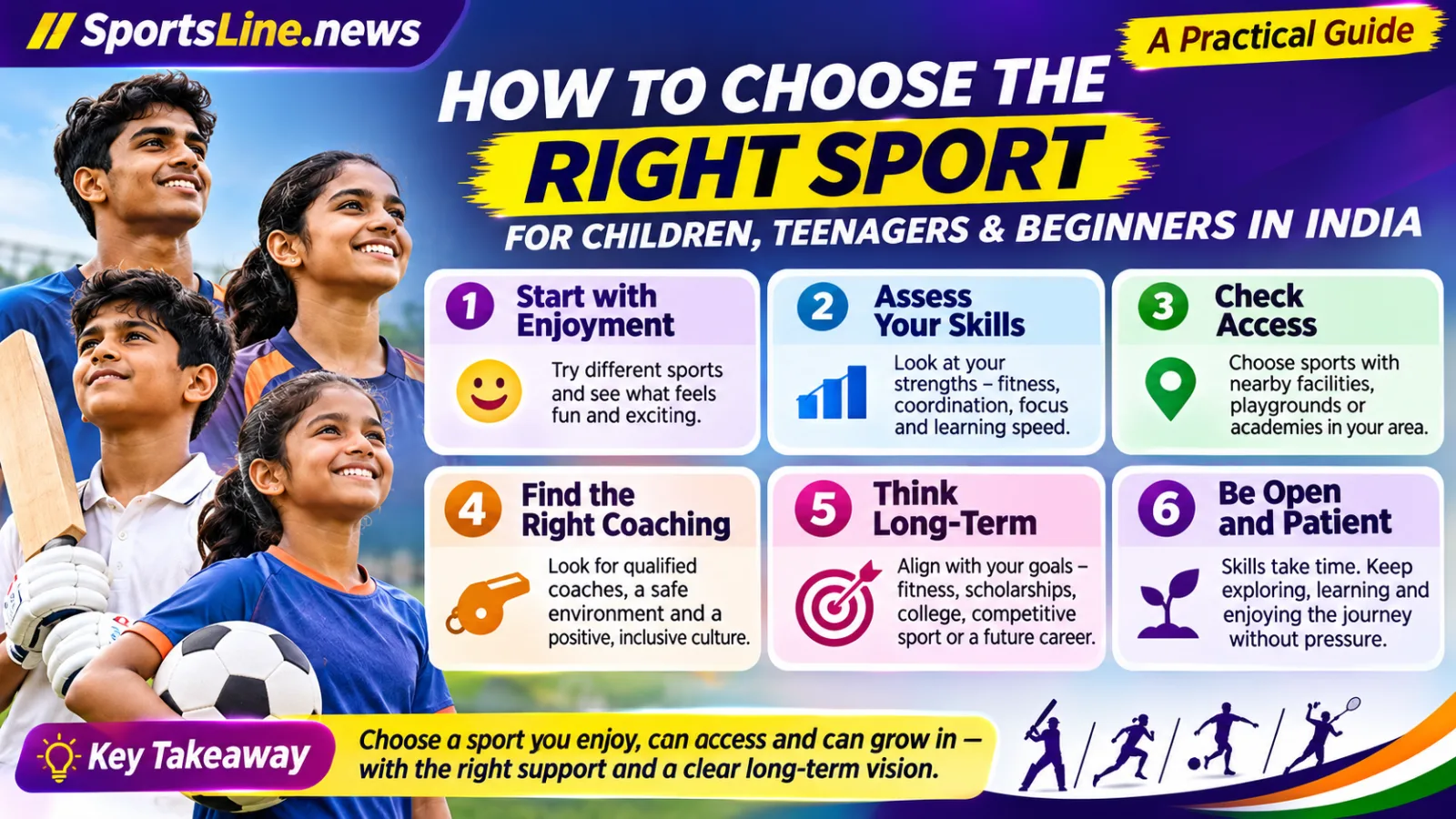
Choosing a sport is easier when you consider more than what is popular or what friends are playing. The right fit usually combines genuine interest, the skills you want to develop, the facilities available to you, and a training routine you can maintain. You do not need to know your strongest ability immediately: trying different activities and getting feedback from a qualified coach can help you make a more informed choice.
1. Start with what you enjoy
Think about the activities that make you want to keep practising. Do you enjoy working with a team, competing one-on-one, improving a personal score, solving tactical problems, or performing a precise movement? Team sports such as football, basketball and volleyball involve shared decisions and coordination. Individual sports such as athletics, swimming, badminton and tennis can offer clear personal goals, though many also involve teams, partners or coaching groups.
Enjoyment matters because progress usually requires repeated practice. You may like watching a sport without enjoying its everyday training, so try a beginner session before making a long commitment. Notice whether you look forward to learning its skills, how you feel after practice, and whether you want to return even when a session is challenging.
2. Explore your current strengths without limiting yourself
Different sports use different combinations of abilities. Speed, endurance, balance, coordination, flexibility, strength, accuracy, reaction time, communication and tactical awareness can all be useful, but no single trait determines whether you will succeed. A coach can help identify current strengths and areas to develop, while safe practice gives you a chance to improve skills that may be new to you.
Use ability as a starting point, not a fixed label. A child who is not yet fast may build speed through suitable training; someone who is new to ball skills can learn with repetition and coaching. Avoid comparing your early performance with experienced athletes. Growth, experience, confidence and access to good instruction can all affect how a beginner performs.
Do not choose based on assumptions about body type, gender, disability or background. Sports have different formats and adaptive pathways, and many activities can be modified to suit an athlete’s needs. If you have a health condition, injury or accessibility concern, discuss suitable participation with an appropriate healthcare professional and the coach or organiser.
3. Consider access, cost and your weekly routine
A sport is more practical when you can reach a suitable venue, attend sessions consistently and afford the necessary equipment and fees. Ask about coaching quality, safety practices, session timings, travel, equipment, competition expenses and whether beginner sessions are available. Some activities need specialised facilities or equipment, while others may be easier to start with locally. Do not commit to a costly programme until you understand what the fees include.
Think about how training fits with school, family responsibilities, transport and rest. A nearby programme you can attend regularly may be more useful at first than a prestigious venue that is difficult to reach. If you are a student, discuss the schedule with your family and school so that training does not routinely replace classes, homework or sleep.
4. Try more than one sport before deciding
If possible, take introductory sessions in two or three sports. Give each a fair chance and ask what a typical week of training looks like. After each trial, note how much you enjoyed it, what skills you found engaging, whether the coach explained things clearly, and whether the time and cost are manageable. A short trial can reveal more than choosing based only on videos or friends’ opinions.
Ask a coach about beginner progression, age groups, safety rules and how improvement is assessed. A welcoming programme should be able to explain its expectations without promising medals, selection or a professional career. For children and teenagers, a parent or guardian should help check the environment, supervision and payment terms.
5. Set a short trial period and review your progress
Once you have chosen a sport to explore, agree on a reasonable trial period with your coach and family. Attend sessions consistently where possible, learn the basic rules and techniques, and set one or two goals that are within reach. Examples include improving a basic skill, completing sessions regularly or understanding game tactics—not just winning a medal.
Review your experience after several weeks. Are you enjoying practice? Do you feel supported and safe? Are you learning? Is the schedule sustainable? You can stay with the sport, change your training approach, try a different discipline or explore another sport. Changing direction after a genuine trial is a normal part of finding a good fit.
6. Plan your next step in India
After choosing a sport, look for a reputable local club, school programme, community facility or recognised academy. Check the relevant state association or national federation for information about rules and competition pathways. The Sports Authority of India and Khelo India websites provide official information about national sports programmes and athlete-development initiatives; availability and eligibility depend on the specific programme.
You can also use a SportsLine Athlete Profile to organise your sporting background and achievements once you begin training and competing. Keep any results and certificates accurate, and remember that a profile does not replace coaching, safe participation or the official requirements of a competition.
The best sport for you is not necessarily the one in which you perform best on your first day. Look for a combination of enjoyment, opportunity to learn, safe coaching and a routine you can maintain. Give yourself permission to explore, ask questions and improve over time.
Sources
Frequently asked questions
How do I know which sport is right for me?
Consider what you enjoy, the skills you want to develop, the coaching and facilities available, and whether the training schedule and cost are manageable. Try introductory sessions in more than one sport if possible. Review whether you enjoy practice, feel safe and supported, and want to keep learning before making a longer commitment.
Should I choose a sport based on my natural talent?
Current strengths can help you explore sports, but they should not be treated as fixed limits. Different sports use combinations of speed, endurance, coordination, balance, accuracy, strength and tactical awareness. Coaching and regular practice can help beginners develop new skills, so early performance alone is not a reliable basis for deciding.
How many sports should a beginner try?
There is no fixed number, but trying two or three introductory sessions across different sports can help you compare enjoyment, coaching, skills and practical requirements. Give each activity a fair chance, ask what regular training involves and consider how it fits your schedule and budget before committing to a programme.
Does choosing the right sport depend on body type or gender?
Body type and gender should not be used as automatic reasons to rule a sport in or out. Sports require different skills and offer different formats, and many activities have adaptive options. Consider your interests, training opportunities and individual needs, and ask a qualified coach or healthcare professional about relevant safety or accessibility questions.
How can parents help a child choose a sport?
Parents can help children try beginner sessions, compare travel and costs, check coaching and safety practices, and create a schedule that leaves room for school and rest. Listen to the child’s own interests rather than choosing only for prestige or medals, and avoid programmes that promise guaranteed selection or a professional career.
Where can beginners find sports programmes in India?
Beginners can ask local schools, community facilities, clubs and reputable academies about introductory sessions. The Sports Authority of India and Khelo India websites provide official information about national sports programmes, while relevant state associations and national federations can explain sport-specific pathways. Check each programme’s current availability, eligibility, fees and safety arrangements.
Events in this post
5th Asian Para Games 2026
Event · Other · Nagoya City · 18 Oct 2026
Celebrate the power of determination, unity, and world-class athleticism at the 5th Asian Para Games, taking place in Aichi-Nagoya, Japan. Under the inspiring motto "Imagine One Heart," this premie...
View event →