
Key points
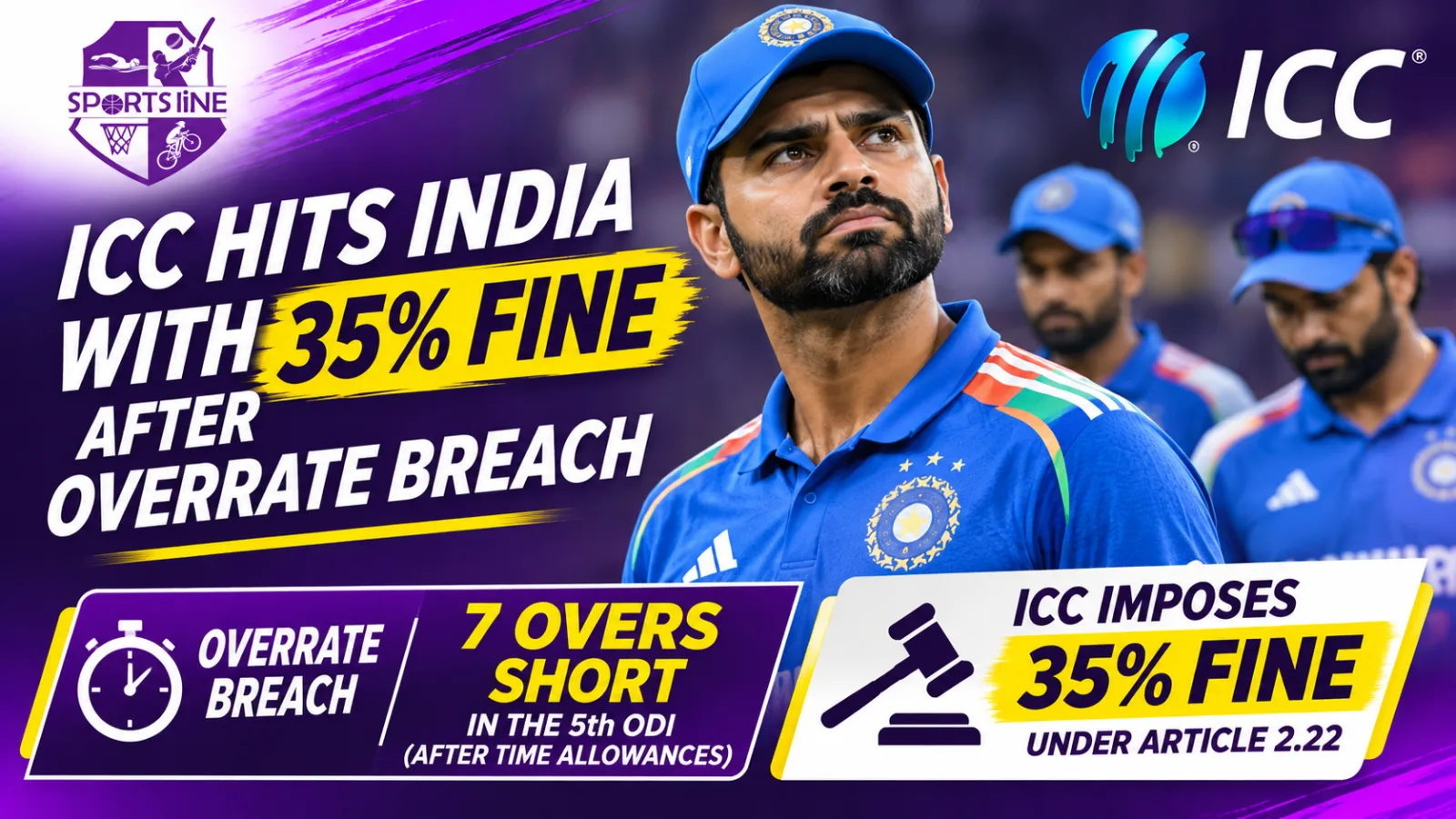
- India were fined 35 per cent of their match fees for a slow over-rate in the fifth ODI against New Zealand.
- The match was played in Mount Maunganui on November 15, 2026.
- India were ruled seven overs short after time allowances were taken into consideration.
- The sanction was imposed by ICC Elite Panel Match Referee Ranjan Madugalle under Article 2.22.
- Players were fined five per cent of their match fees for each over short, with the maximum penalty capped at 50 per cent.
- Stand-in captain Shreyas Iyer pleaded guilty and accepted the sanction, so no formal hearing was required.
- India won the fifth ODI by 22 runs and sealed the five-match series 3-1.
- India’s successful ODI tour of New Zealand ended with a disciplinary setback, as the International Cricket Council fined the visitors 35 per cent of their match fees for maintaining a slow over-rate in the fifth and final match at Mount Maunganui on November 15. The penalty came despite India winning the contest by 22 runs and sealing the five-match series 3-1.
The ICC ruled that Shreyas Iyer’s side had fallen seven overs short of the required rate after time allowances were taken into consideration. Iyer, who led India as stand-in captain, pleaded guilty and accepted the proposed sanction. As a result, the matter did not require a formal hearing.
Why India were penalised after the series win
The offence took place during the fifth ODI against New Zealand at Mount Maunganui. India had entered the final match looking to close out the series, and did so with a 22-run victory. However, the time taken to complete the innings meant the team did not meet the ICC’s minimum over-rate requirement.
After accounting for the permitted time allowances, India were found to be seven overs behind the required rate. The ICC therefore imposed a fine of 35 per cent of the players’ match fees. The sanction was handed down by Ranjan Madugalle of the ICC Elite Panel of Match Referees.
The charge was brought by the match officials: on-field umpires Paul Reiffel and Wayne Knights, third umpire Kumar Dharmasena and fourth umpire Chris Brown. The ICC’s announcement confirmed that Iyer accepted the charge and the proposed penalty, avoiding the need for a disciplinary hearing.
How the ICC fine is calculated
The sanction was imposed under Article 2.22 of the ICC Code of Conduct for Players and Player Support Personnel, which deals with minimum over-rate offences. Under the rule, players are fined five per cent of their match fees for every over their side is short of the required rate.
India’s seven-over shortfall therefore resulted in a 35 per cent fine: seven overs multiplied by five percentage points per over. The regulation also places a ceiling on the penalty, with the maximum fine set at 50 per cent of the players’ match fees. India’s sanction was below that maximum.
The rule is intended to ensure that teams complete their overs within the allotted time and that matches progress at the required pace. The calculation is made after relevant time allowances are considered, which is why the ICC’s official finding specified that India were seven overs short after those adjustments.
Iyer accepts responsibility as stand-in captain
Shreyas Iyer was leading India in the final stages of the ODI series. The ICC statement said that he pleaded guilty to the offence and accepted the proposed sanction. That acceptance meant there was no need for a formal hearing to determine the charge.
The penalty was a team over-rate sanction applied to the players’ match fees, rather than a change to the result of the match. India’s victory and the 3-1 series scoreline remained intact. The fine nevertheless provided a disciplinary footnote to a tour in which the team had to adapt to challenging conditions and a series of fluctuating performances.
India finish the series with a 3-1 victory
The fifth ODI was a low-scoring contest. India were bowled out for 209, with Ishan Kishan and Axar Patel each making 46 to help the visitors recover from an early wobble. New Zealand were then dismissed for 187, giving India a 22-run win and the series by a 3-1 margin.
India’s bowlers played the decisive role in defending the modest total. Arshdeep Singh led the attack with three wickets, while Mohammed Siraj and Axar Patel took two each. The result completed a hard-fought series in which the teams had experienced contrasting fortunes across the five matches.
The ICC fine does not take away from the series result, but it highlights the importance of maintaining the required pace even when a match is tight. For India, the final ODI delivered the desired trophy outcome and an avoidable penalty. The official sanction was based on the seven-over shortfall, with Iyer’s acceptance closing the disciplinary matter without a hearing.
Frequently asked questions
Why was India fined by the ICC after beating New Zealand?
India were fined for maintaining a slow over-rate in the fifth and final ODI at Mount Maunganui on November 15. After time allowances were considered, the team was found to be seven overs short of the required rate, triggering a sanction under Article 2.22 of the ICC Code of Conduct.
How much was India fined for the slow over-rate?
India were fined 35 per cent of their match fees. The ICC calculation is five per cent for every over a team falls short of the required rate. India were seven overs short after time allowances, resulting in the 35 per cent penalty.
Who imposed the penalty on India?
The sanction was imposed by Ranjan Madugalle of the ICC Elite Panel of Match Referees. The charge was brought forward by on-field umpires Paul Reiffel and Wayne Knights, third umpire Kumar Dharmasena and fourth umpire Chris Brown.
Did Shreyas Iyer accept the ICC charge?
Yes. India’s stand-in ODI captain Shreyas Iyer pleaded guilty to the slow-over-rate offence and accepted the proposed sanction. Because he accepted the charge, there was no need for a formal hearing, according to the ICC statement.
Did India still win the ODI series against New Zealand?
Yes. India won the fifth ODI by 22 runs after defending a total of 209, and secured the five-match series 3-1. The fine related to the team’s over-rate during that final match and did not change the match result or series outcome.