
Key points
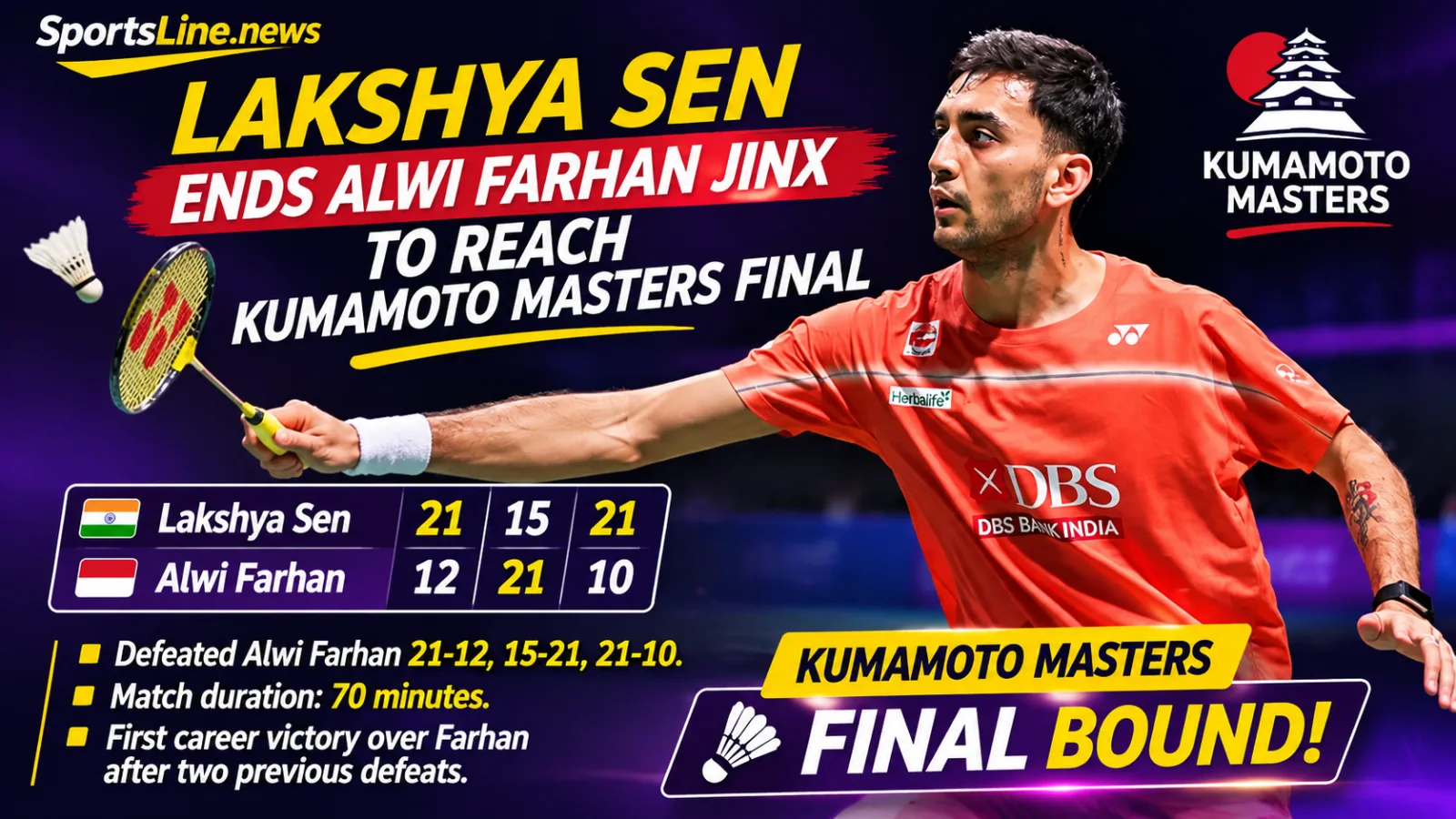
- Lakshya Sen beat Indonesia’s Alwi Farhan 21-12, 15-21, 21-10 in the Kumamoto Masters Japan semi-final on November 14, 2026.
- The match lasted 70 minutes and sent Sen into his second successive BWF World Tour Super 500 final.
- Sen had lost both previous meetings with Farhan and had not taken a game off the Indonesian before the semi-final.
- Sen used flat, fast drives, straight pushes and net control to limit Farhan’s attacking opportunities.
- Farhan levelled the match by taking the second game 21-15, but Sen built a 16-9 lead in the decider before closing it out 21-10.
- Sen, ranked world No. 13, defeated the world No. 10 and strengthened his bid for a place at the season-ending World Tour Finals.
Lakshya Sen produced a controlled and tactically sharp performance to defeat Indonesia’s Alwi Farhan 21-12, 15-21, 21-10 in the men’s singles semi-final of the Kumamoto Masters Japan on November 14. The 70-minute victory sent the Indian into his second consecutive BWF World Tour Super 500 final and gave him his first win over the world No. 10 after losing their previous two meetings.
Sen, ranked world No. 13, did not try to match Farhan’s attacking game on the Indonesian’s terms. Instead, he used flat, fast drives, straight pushes and a strong presence at the net to deny his opponent the high lifts and comfortable overhead positions that allow him to unleash his powerful smashes. The plan worked especially well in the opening game and the decider.
Sen changes the pattern against Farhan
The semi-final carried an additional challenge for Sen because Farhan had won both of their earlier encounters. The Indonesian had beaten him without dropping a game, and his deceptive overhead attack had caused problems in those matches. This time, Sen altered the rally patterns and refused to give Farhan the time and height required to attack freely.
Sen’s use of the parallel game was central to the change. Rather than repeatedly lifting the shuttle and allowing Farhan to jump into his preferred attacking positions, the Indian played quick, flat exchanges and pushed the shuttle straight. His net control also forced Farhan to make more decisions from uncomfortable positions and reduced the Indonesian’s ability to dictate rallies.
The approach brought Sen the first game 21-12. He controlled the tempo and kept Farhan from building the kind of attacking rhythm that had decided their earlier meetings. The Indian also found opportunities to attack with depth and power, making it difficult for Farhan to turn defence into offence.
Farhan responds, but Sen owns the decider
Farhan found a response in the second game. The Indonesian increased his pressure and managed to restore parity by taking the game 21-15. The contest was now level, and Sen had to reset rather than allow the momentum shift to carry into the deciding game.
The third game showed the value of the Indian’s tactical discipline. Sen moved quickly towards the net, continued to keep the shuttle flat and made Farhan work for every attacking opportunity. He opened a substantial 16-9 lead and continued to build pressure. His sharp backhand reflexes helped him reach 18-9, while Farhan’s frustration became increasingly visible as the Indian maintained control.
Sen also produced notable power, with The Indian Express reporting a smash reaching 422 km/h. More important than the speed was the placement and timing: Sen used the straight attacking line, including towards Farhan’s backhand, to prevent the Indonesian from setting up his preferred reply. Sen closed the decider 21-10 to complete the upset.
A statement win and a second straight Super 500 final
The victory was significant beyond the scoreline. Sen had entered the tournament seeking a strong finish to a season that had included uneven results and periods of managing fitness concerns. He had reached the Kumamoto semi-finals in 2025, and his latest performance took him one step further by securing a place in the final.
The Indian’s season had included an All England final and a title-winning run at the Hylo Open, alongside early exits at other tournaments. His Kumamoto campaign continued a late-season push, with the win over Farhan especially important because it came against a higher-ranked opponent who had previously held a clear head-to-head advantage.
Sen was also in contention for the final qualification places at the season-ending BWF World Tour Finals. Reaching the Kumamoto final strengthened his position in that race. The Indian Express noted that he was competing with Japan’s Koki Watanabe for the final spot, with Watanabe due to play the other semi-final against Thailand’s Kunlavut Vitidsarn.
What made the tactical shift work?
Farhan is at his most dangerous when he can move into the rear court, create elevation and attack with his overhead strokes. Sen’s flat drives and fast pushes took away that space. By keeping the shuttle low and direct, he made Farhan generate pace from less comfortable positions and reduced the number of clean opportunities to smash.
The net game completed the plan. Sen was aggressive when moving forward, but he did not rush into uncontrolled attacks. He varied the pace, kept his lines compact and made Farhan play additional shots. The result was a performance that combined patience with decisive finishing, particularly after the second-game setback.
For Sen, the semi-final was a reminder that tactical adjustment can change a head-to-head rivalry. He had not taken a game off Farhan in their first two meetings; in Kumamoto, he won two games and controlled the most important stretch of the match. The victory placed him in another Super 500 final and gave his late-season campaign a major boost.
Frequently asked questions
What was the score between Lakshya Sen and Alwi Farhan at Kumamoto Masters 2026?
Lakshya Sen defeated Alwi Farhan 21-12, 15-21, 21-10 in the men’s singles semi-final on November 14. The match lasted 70 minutes and sent the Indian into the final of the Kumamoto Masters Japan, a BWF World Tour Super 500 tournament.
How did Lakshya Sen beat Alwi Farhan?
Sen used flat, fast drives, straight pushes and an aggressive net game to stop Farhan from getting into his preferred attacking positions. He took the first game 21-12, lost the second 15-21, then controlled the decider and won it 21-10.
Was this Lakshya Sen’s first win against Alwi Farhan?
Yes. Sen had lost both of his previous meetings with the Indonesian and had not taken a game off him. The Kumamoto semi-final was their third recorded meeting, and Sen reversed that record with a three-game victory.
How long did Lakshya Sen’s Kumamoto Masters semi-final last?
The semi-final between Lakshya Sen and Alwi Farhan lasted 70 minutes. Sen won the opening game comfortably, dropped the second, and then established a commanding 16-9 lead in the deciding game before finishing the match 21-10.
Which tournament final has Lakshya Sen reached in Kumamoto?
Sen reached the men’s singles final of the Kumamoto Masters Japan, a BWF World Tour Super 500 event. It was his second consecutive Super 500 final, following his strong late-season run and his previous appearance in the Kumamoto semi-finals in 2025.
What was Lakshya Sen’s ranking compared with Alwi Farhan?
At the time of the semi-final, Lakshya Sen was ranked world No. 13 and Alwi Farhan world No. 10. Sen therefore beat a higher-ranked opponent to reach the final, after previously losing both of their head-to-head matches.