
Key points
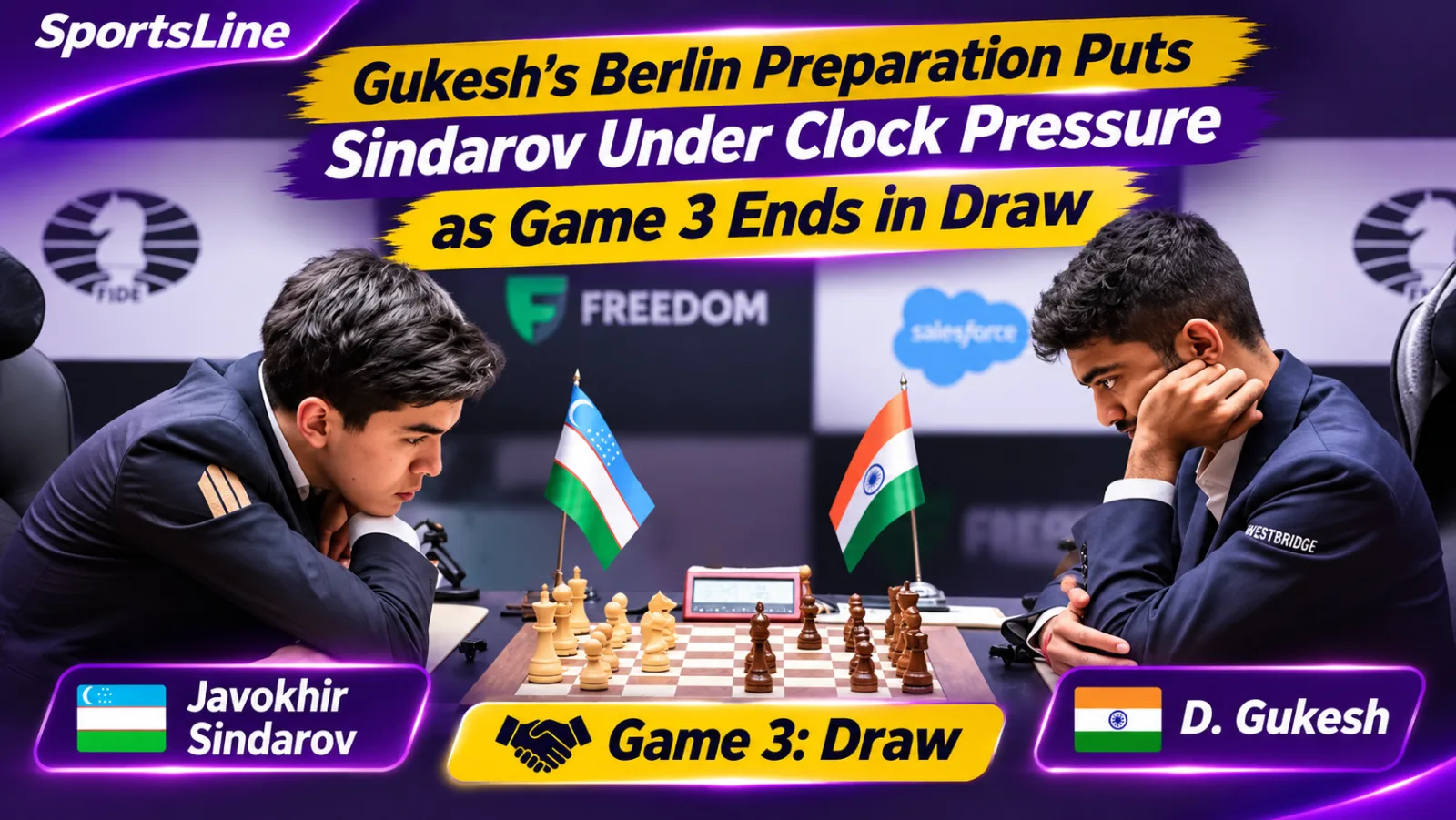
- D Gukesh and Javokhir Sindarov drew Game 3 of the 2026 World Chess Championship after 60 moves in Geneva on November 26.
- Gukesh used the Berlin Defence with Black and surprised Sindarov with a deeply prepared continuation.
- Sindarov spent substantially more time in the opening and reached the first time control with only seconds remaining.
- The game lasted approximately four hours and 49 minutes, making it the longest contest of the match so far.
- The result left the 14-game match level at 1.5 points each after three consecutive draws.
- Game 4 is scheduled for November 28, with Gukesh playing White after the first rest day.
Defending champion D Gukesh produced a confident display of opening preparation to hold Javokhir Sindarov to a draw in Game 3 of the 2026 World Chess Championship in Geneva on Thursday, November 26. Playing with the black pieces, the Indian grandmaster relied on the Berlin Defence and appeared to have anticipated the challenger’s plans, leaving Sindarov to spend valuable time finding a way through the opening.
The contest eventually ended in a draw after 60 moves and nearly five hours at the board. The result kept the match level at 1.5-1.5 after three games, but it was a different kind of draw from the brief encounters that opened the championship. Gukesh had the more comfortable position for long stretches and built a significant advantage on the clock, while Sindarov showed resilience to survive the pressure.
Gukesh’s Berlin preparation changes the rhythm
Sindarov began with 1.e4, and Gukesh answered with 1...e5 before steering the game into the Berlin Defence. The Indian chose a continuation that differed from the line seen earlier in the match, and the preparation appeared to catch the Uzbek challenger off guard. Gukesh moved quickly through the early phase, while Sindarov had to pause repeatedly to work out the best responses.
Reports from the game noted that Gukesh completed his first 15 moves in a little over two minutes. Sindarov, by contrast, used a substantial portion of his time navigating the position. The difference created a sizeable clock advantage for the defending champion and shifted the pressure onto the challenger much earlier than in the first two games.
The Berlin Defence is one of the most recognisable systems in elite chess. Its World Championship history is closely associated with Vladimir Kramnik, who used it to great effect against Garry Kasparov in their 2000 title match. Gukesh’s choice brought that historical association back into focus, while the particular move order gave him a position he appeared to understand deeply.
Sindarov fights through severe time pressure
Although Gukesh looked comfortable in the opening, Sindarov continued searching for practical chances. The game became more tense when the challenger advanced his kingside pawns, including the ambitious 29.f4, in an effort to disturb Black’s coordination and create attacking possibilities. Gukesh responded calmly and continued to look for ways to use his position and passed-pawn prospects.
The critical moment came as the players approached the first time control. Sindarov was left with only a handful of seconds to complete the required moves before receiving the additional time allocation. He managed to reach the control, avoiding an immediate collapse under pressure. Once the extra time and increment became available, the challenger was able to stabilise the position and continue defending.
Gukesh still had reasons to press. He had enjoyed the more favourable clock situation and looked for ways to advance his passed pawn and make progress. Sindarov, however, used active king play and accurate defensive moves to limit the danger. The game gradually moved away from the sharpest possibilities and into a technical endgame.
A 60-move draw leaves the match level
After the rooks were exchanged, the players reached an endgame with opposite-coloured bishops. Such positions can be difficult to win even when one side has a small material or positional edge, because the bishops operate on different-coloured squares and can help create defensive barriers. Sindarov’s king activity and defensive coordination made it difficult for Gukesh to convert his pressure into a decisive advantage.
The players continued for 60 moves before agreeing to a draw. The game lasted approximately four hours and 49 minutes, making it the longest encounter of the match so far. It was also the first game in which either player had sustained chances to push for more than a brief opening advantage, even though the final result remained a half-point apiece.
The first two games had also ended in draws, but they followed very different paths. Game 1 was a 38-move encounter, while Game 2 ended after only 20 moves through repetition in the London System. Game 3 offered a longer strategic and tactical battle, with Gukesh’s preparation and Sindarov’s time management becoming central themes.
Rest day before Gukesh gets White in Game 4
The draw leaves both players on 1.5 points after three of the scheduled 14 classical games. The championship now moves into its first rest day on Friday, November 27, before play resumes on Saturday. Gukesh will have the White pieces in Game 4 and will look to build on the confidence gained from his performance with Black.
The match is being played under a format in which the first player to reach 7.5 points wins the title. If the score is tied 7-7 after all 14 classical games, shorter-format tiebreaks will determine the champion. With 11 classical games still to come, the drawn start leaves the contest wide open.
For Gukesh, Game 3 offered evidence that his preparation can put Sindarov under pressure, even when he is playing Black. For the challenger, surviving the time scramble and holding the endgame will be a source of confidence. The next game will test whether Gukesh can turn his improved preparation into a first win of the title defence.
Frequently asked questions
What happened in Game 3 of the 2026 World Chess Championship?
Defending champion D Gukesh and challenger Javokhir Sindarov played out a 60-move draw in Geneva on November 26. Gukesh used the Berlin Defence with Black and appeared better prepared in the opening, putting Sindarov under significant time pressure before the challenger defended to secure a draw.
What was the match score after Game 3?
The match remained level at 1.5-1.5 after three games. All three encounters had ended in draws, although Game 3 was a much longer and more complex contest than the 20-move draw in Game 2.
Which opening did Gukesh use against Sindarov?
Gukesh employed the Berlin Defence against Sindarov’s 1.e4. His chosen continuation caught the challenger by surprise and required Sindarov to spend considerable time calculating in the opening, giving Gukesh a substantial advantage on the clock.
How long did Game 3 last?
Game 3 lasted 60 moves and approximately four hours and 49 minutes. It was the longest game of the match at that stage, with both players continuing to look for chances before the position simplified into an opposite-coloured-bishops endgame.
When is Game 4 of Gukesh vs Sindarov?
Game 4 is scheduled for Saturday, November 28, 2026, after the match’s first rest day. Gukesh will have the White pieces when the 14-game classical World Championship contest resumes in Geneva, Switzerland.