Ranji Trophy: History, Origin, Politics and Evolution of India's Premier Domestic Cricket Tournament
By Chahel ChhedaPublished:
The Ranji Trophy is the backbone of Indian domestic cricket. Discover how political rivalries, nationalism and the decline of the Bombay Quadrangular shaped the tournament's fascinating history and legacy.
The Ranji Trophy is the backbone of Indian domestic cricket.
The Ranji Trophy is India’s premier domestic cricket tournament, conducted annually by the BCCI. Currently, 38 teams participate, representing various states, regions, and union territories of India, with Railways and Services being the only pan-India participants. Played in the purest format of the game, the Ranji Trophy has long been the crown jewel of Indian cricket, and participation in it remains a dream for countless aspiring cricketers across the nation.
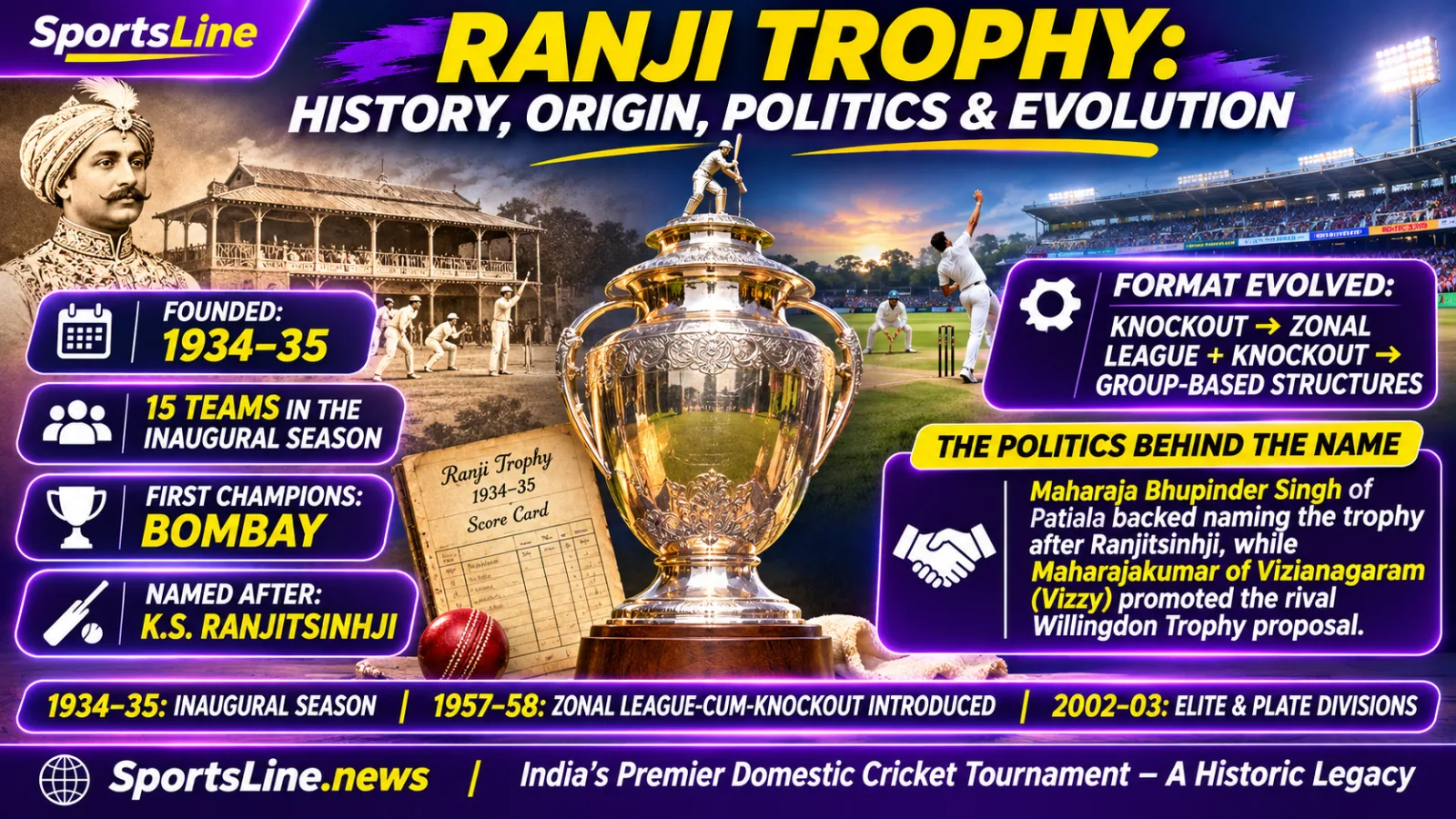
The elite competition came into existence following a meeting conducted by the BCCI in Shimla in July 1934. Upon the proposal of the then BCCI president and founder, A.S. De Mello, the tournament was first played later that year.
However, the establishment of India’s first-ever national cricket tournament was influenced by multiple factors — interestingly, the primary ones were rooted in the nation’s favourite subject of discussion — politics. It is believed that during the pre-independence era, two rulers of princely states had engaged in a silent rivalry to assert their dominance over Indian cricket. This battle was between the Prince of Patiala, Bhupinder Singh, and the ambitious Maharajakumar of Vizianagaram, popularly known as Vizzy.
It is also said that the tournament was initially intended to be named in honour of India’s then Governor-General, Lord Willingdon, at Vizzy’s insistence. However, at its inception, it was titled the ‘Cricket Championship of India.’ Eventually, due to the generous donation and persistence of the Maharaja of Patiala, the tournament was renamed to honour India’s first-ever international cricketer, Ranjitsinhji, who had represented England from 1896 to 1902.
Another driving force behind the emergence of the Ranji Trophy was the political climate of India during the 1930s and 1940s. After decades of colonial oppression and caste-based divisions, India was yearning for nationalism and communal harmony. At the time, the country’s most popular cricket event — the Bombay Quadrangular — faced increasing criticism. The Quadrangular was viewed as a symbol of communal divide, as it featured teams representing Hindus, Muslims, Parsis, Europeans, and later, the Rest, with communal pride closely tied to team performances.
Politicians and journalists began advocating for a zonal tournament that would replace the communal Quadrangular, eventually leading to the birth of the Ranji Trophy. However, in its early years, the Quadrangular continued to attract more audiences due to its established legacy, while the newly founded Ranji Trophy was still finding its footing.
It was not until 1946 that the Quadrangular was finally abolished, paving the way for the Ranji Trophy to become India’s premier domestic cricket tournament. Since then, it has served as the backbone of Indian cricket, nurturing countless talents who have gone on to represent the nation.
The inaugural season of the Ranji Trophy featured 15 teams. Today, it comprises 38 teams divided into two tiers, following a promotion and relegation system similar to European football. The tournament has been historically dominated by Mumbai, regarded as the hub of Indian cricket, with the city clinching the title a record 42 times, including an unprecedented streak of 15 consecutive wins from 1958–59 to 1972–73.
However, ever since the advent of T20 cricket and the widespread adoption of white-ball cricket along with the growing popularity of the IPL, the Ranji Trophy has in some sense lost its charm and significance as the attention of the youth has shifted from the skill of red-ball cricket to the glamour of white-ball cricket.
Nevertheless, despite its declining mass appeal, the Ranji Trophy remains the pinnacle of domestic cricket in India — a timeless institution that continues to uphold the spirit and depth of Indian cricket’s legacy.
The Ranji Trophy was established in 1934 following a meeting of the Board of Control for Cricket in India (BCCI) in Shimla. The inaugural edition was played during the 1934–35 season.
Why is the tournament called the Ranji Trophy?
The tournament was named after Ranjitsinhji, widely regarded as one of India's greatest early cricketers and the first Indian to play international cricket for England.
Who won the first-ever Ranji Trophy?
Bombay (now Mumbai) won the inaugural Ranji Trophy in the 1934–35 season, defeating Northern India in the final.
Which team has won the most Ranji Trophy titles?
Mumbai holds the record for the most Ranji Trophy titles, having won the championship 42 times. The team also achieved an extraordinary run of 15 consecutive titles between 1958–59 and 1972–73.
How many teams participate in the Ranji Trophy?
A total of 38 teams participate in the Ranji Trophy, representing different Indian states, regions and union territories, along with Railways and Services.
Why was the Ranji Trophy introduced?
The Ranji Trophy was introduced to establish a national-level cricket competition based on regional representation. It also emerged amid growing criticism of the Bombay Quadrangular, which was organised along communal lines.
Is the Ranji Trophy played in Test cricket format?
Yes. The Ranji Trophy is a first-class cricket tournament played in the multi-day red-ball format, following rules similar to Test cricket.
Why is the Ranji Trophy important for Indian cricket?
The Ranji Trophy provides a platform for domestic cricketers to showcase their skills in first-class cricket. It has played a crucial role in developing players who have gone on to represent the Indian national team.
The Ranji Trophy 2026–27 is India's premier domestic first-class cricket tournament, bringing together teams from across the country to compete for one of the most prestigious titles in Indian dome...