
Key points
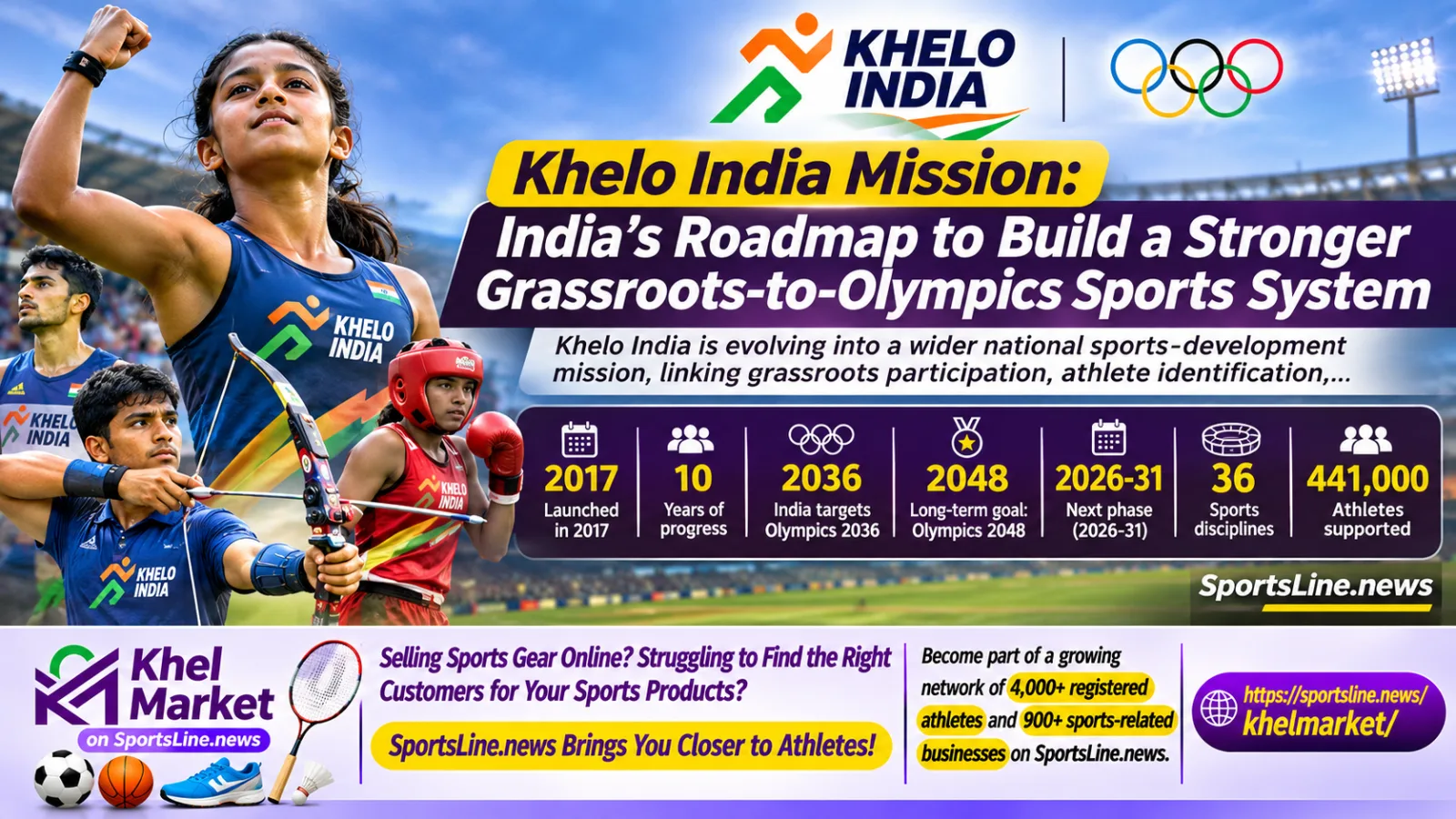
- The Khelo India programme was launched in 2017 to strengthen grassroots participation, talent development and sports infrastructure.
- The official mission page sets an ambition for India to rank among the top 10 nations at the 2036 Olympics and top five by 2048.
- The mission page lists nine strategic components, including infrastructure, competitions, training facilities, talent development, coaching, sports technology and the Fit India Movement.
- The Union government announced a restructured Khelo India Scheme for 2026-31 with a total outlay of ₹36,441 crore.
- The 2026-31 framework envisages support for 9,000 Khelo India Athletes and 18,000 Emerging Khelo India Athletes across 30 priority sports.
- The expanded framework includes a National Coach Accreditation Board and the AI-enabled Khel Setu digital platform.
- The KIRTI initiative focuses on identifying and nurturing sporting talent among children aged 9 to 18.
India’s sporting ambitions depend on more than success at major international events. They require a system that can identify talent early, provide access to quality coaching and facilities, create regular competition opportunities and support athletes as they progress towards elite performance. The Khelo India Mission is designed around that broader challenge, bringing grassroots participation and high-performance development into a connected national framework.
Launched in 2017, Khelo India was created as a flagship programme to strengthen sports participation, talent development and infrastructure. The mission has since expanded across school, university, youth, winter, para and other sporting platforms. Its current official mission page presents a long-term vision that links a stronger domestic sports ecosystem with India’s ambitions for the Olympic Games in 2036 and 2048.
From grassroots participation to national sporting ambition
The programme’s central idea is to make sport more accessible while building a clearer route for talented athletes to progress. Grassroots participation helps widen the pool of young people taking part in sport. Structured competitions and assessment can then help identify promising performers, while training facilities, qualified coaches and athlete support are intended to help them develop.
The official Khelo India timeline traces several milestones in this development. The first School Games and athlete scholarship scheme followed the programme’s launch. Youth Games expanded the platform, while University and Winter Games added further competitive opportunities. Khelo India Centres, State Centres of Excellence, Para Games, the ASMITA League and Beach Games have contributed to a wider sporting landscape.
The mission page also sets out long-term Olympic ranking ambitions: a place among the top 10 nations in 2036 and among the top five in 2048. These targets express the scale of the country’s ambition. Achieving them will depend on sustained investment, athlete development, strong institutions, coaching quality, sports science and the ability to translate participation into international performance.
Nine strategic components shape the mission
The current mission overview groups its approach into nine strategic components. These cover strengthening strategic sports assets, developing infrastructure for medal strategies, supporting state-level infrastructure plans, organising sports competitions and leagues, expanding Khelo India training facilities, identifying and developing talent, improving coaches and support staff, using sports technology and promoting the Fit India Movement.
Together, these areas address different stages of the sporting pathway. Infrastructure and training facilities provide places to practise and compete. Competitions give athletes opportunities to test themselves. Talent identification helps spot potential, while coaching and support staff development aim to improve the quality of athlete preparation. Sports technology can strengthen assessment, administration and performance monitoring. The Fit India Movement extends the mission beyond competitive sport by encouraging physical activity among the wider population.
The Ministry of Youth Affairs and Sports has also described Khelo India as a programme with wider social objectives. Its official scheme information highlights community development, social integration, gender equality, healthy lifestyles, national pride and economic opportunities connected to sports. This means the programme is not limited to producing elite athletes; it also seeks to make sport a more visible and accessible part of everyday life.
Khelo India 3.0 and the expanded 2026-31 framework
A major step in the programme’s latest phase came with the government’s announcement of a restructured Khelo India Scheme for 2026-31. The Press Information Bureau reported a total outlay of ₹36,441 crore, describing the expansion as a realignment with the Khelo Bharat Policy 2025 and India’s long-term Olympic vision.
The expanded framework envisages nurturing 9,000 Khelo India Athletes and 18,000 Emerging Khelo India Athletes across 30 priority sports disciplines. The announced support package includes coaching, boarding and diet, sports kits, travel, medical assistance, academic support and wider competitive exposure. The stated objective is to create more systematic support as athletes move through different stages of development.
The restructuring also places emphasis on sports infrastructure and training pathways. The government outlined a three-tier infrastructure framework covering strategic sports assets, facilities linked to medal strategies and state action plans for local infrastructure development. The approach is intended to address gaps in facilities and connect investment more closely with the requirements of priority sports.
Talent identification, coaching and technology
Talent identification is one of the most important links in the mission. The Khelo India Rising Talent Identification initiative, known as KIRTI, focuses on children aged 9 to 18. It uses Talent Assessment Centres, standardised assessment protocols and technology-supported evaluation to help identify sporting potential through a more structured process.
The wider 2026-31 framework also envisages a National Coach Accreditation Board to standardise coaching qualifications and professional standards. This recognises that athlete development depends not only on facilities and competition but also on the expertise of coaches and the support teams working with athletes every day.
Technology is another major element. The government announcement describes Khel Setu as an AI-enabled digital platform intended to integrate athlete information, talent scouting, sports administration and grievance mechanisms. Digital systems can help connect information across the athlete journey, although their impact will depend on effective implementation, data quality and access for the organisations and athletes expected to use them.
Why the mission matters for Indian sport
A stronger national sports system needs pathways that are visible and accessible beyond a small number of established centres. Local facilities, school and university competitions, community coaching and talent assessment can help more young people enter organised sport. For athletes who show potential, reliable coaching, medical support, equipment, education and regular competition can make the difference between early promise and sustained progress.
Inclusion is also central to the mission’s wider purpose. The programme’s evolution has included para-sport platforms, women-focused competitions and the promotion of indigenous sporting disciplines. The goal of encouraging participation as a people’s movement places equal importance on the social value of sport: health, confidence, community connection and opportunities for people from different backgrounds.
Khelo India’s long-term targets are ambitious, and progress will need to be measured through outcomes: the quality and reach of facilities, the effectiveness of talent pathways, the standard of coaching, athlete retention and results at major competitions. The 2026-31 expansion gives the programme a larger framework and a significant stated financial commitment. Its lasting success will depend on how consistently these plans reach athletes and sporting communities across India.
By connecting participation, infrastructure, competition, talent development, coaching and technology, Khelo India seeks to build a more complete pathway for Indian sport. The mission is ultimately about creating the conditions in which athletes can emerge from every part of the country and have the support needed to pursue excellence.
Frequently asked questions
What is the Khelo India Mission?
Khelo India is the Government of India’s national sports-development programme. It aims to widen participation, improve sporting infrastructure, identify and nurture athletes, strengthen coaching and create pathways that can take talent from grassroots sport towards elite international competition.
When was the Khelo India programme launched?
The Khelo India programme was approved and launched in 2017. It brought together earlier sports-development initiatives under a unified national framework intended to strengthen grassroots participation, talent development and sporting infrastructure across the country.
What are India's Olympic ambitions under the Khelo India vision?
The official Khelo India mission page outlines an ambition for India to rank among the top 10 nations at the 2036 Olympic Games and among the top five by 2048. These are long-term strategic goals, not guaranteed competition outcomes.
What is the budget for the restructured Khelo India Scheme for 2026-31?
The Union government announced a total outlay of ₹36,441 crore for the restructured Khelo India Scheme covering 2026-31. The expansion is intended to strengthen the sports ecosystem from grassroots participation through athlete development and high-performance support.
How many athletes are expected to receive support under the expanded scheme?
The 2026-31 framework envisages nurturing 9,000 Khelo India Athletes and 18,000 Emerging Khelo India Athletes across 30 priority sports disciplines. The plan also outlines wider support such as coaching, boarding, diet, equipment, travel, medical and academic assistance.
What is the KIRTI talent identification initiative?
Khelo India Rising Talent Identification, or KIRTI, is designed to identify and nurture sporting talent among children aged 9 to 18. It uses Talent Assessment Centres, standardised assessment protocols and technology-supported evaluation to help create a more structured pathway for young athletes.